Author: mmarymckenna

I'm a technology entrepreneur & these days angel investor. I co-founded wildly successful online learning company Learning Pool in 2006 on the back of a long local government career and a spell as a Silicon Valley dotcommer. I exited the company in May 2014 in order to get back into startup land. I invest in female founding teams working on #techforgood projects where I, through my experience or network, can add value. I'm interested in helping start & grow indigenous European companies and especially in working with young and female entrepreneurs. I'm one of Said Business School's (University of Oxford) Resident Experts, an Expert Advisor to the EU's flagship innovation programme the EIC Accelerator & a trustee/non exec director of several startups, not for profits and social enterprises/charities. I co-founded AwakenHub in Ireland with four of my friends in July 2020. We're a vibrant & growing cross-border female founder community and in 2023, we launched Ireland's first and only women-led angel syndicate, AwakenAngels. I love the arts and have been a non executive director on the board of Derry’s Millennium Forum & Theatre for many years. In the 2014 New Year’s Honours I was awarded the MBE by HM the Queen for services to digital technology, innovation and learning - which you have to admit is pretty darned cool. I'm interested in having conversations about non exec positions in tech startups or scaleups and I'm happy to speak at relevant events or write articles for publication on any of my specialist topics - how to build a kick ass network, how to scale your startup, how to build a digital business, how to build a company with a great culture ... I blog mainly about startup business and being an entrepreneur but also other things that I encounter in my travels that interest me. I've sat at Buzz Aldrin's feet & listened to his stories, I've disco danced with Leonard Cohen at Coachella and I've joined Robert Plant in singing gospel songs with Wanda Jackson at Pappy & Harriet's in the Californian desert. You can follow me on Twitter at @MMaryMcKenna

Top 10 Tips for your Iceland Roadtrip

Snow covered mountains near Stykkisholmur

Snow covered mountains near Stykkisholmur

Just back from an amazing 2,000 km 5 day roadtrip around Iceland & thought I would share my top tips.  Also – if like me you’ve been meaning to go to Iceland for the past 25 years but just haven’t got round to it yet my best advice is just go.  Easyjet flies there now (even from Belfast!) so there’s no excuse.  It’s really unusual & well worth it.

Icebergs at Jokulsarlon

Icebergs at Jokulsarlon

A quick caveat – on this trip we didn’t go to Reykjavik or the Blue Lagoon & we didn’t see the Northern Lights (as it’s June, it doesn’t get dark at all).  We’re saving all that for a short winter break instead.  We flew into Keflavik airport & spent the first night at Flokalundur in the West Fjords, second night in Svalbardseyn on the fjord just north of Akureyri, third night in Skalafell near Hofn and the final night in the shadow of that troublesome volcano that no-one can pronounce the name of, Eyjafjallajokull.  Here are my tips.

1 It’s all about the outdoors.  3 of the 4 hotels we stayed in didn’t even have a tv in the room although all had decent wifi.  Everything you’re there to see is outside.  Apart from in the main cities & towns, most restaurants & bars are located in hotels that are open from June to September.  Dinner service finishes at 9pm pretty much universally.  Don’t go if you need to be entertained.

2 Don’t judge distances by the distance, judge it by the state of the roads and pay attention to your maps.

Big Country!

Big Country!

We classified our 2,000 km of roads into Levels 1 to 5 with 1 being the best (tarmac or good surface, single lane going in each direction) and 5 being roads that are under repair or construction.  The 120 mile evening round trip from our hotel in Flokalundur to the bird cliffs at Latrabjarg took us 5 hours & we completely missed dinner.  However, it was so worth it because getting to Latrabjarg & back felt like a real adventure – it’s remote even by Icelandic standards.  The birds there are so unused to humans that you can get very close to them as they have no fear.  Also – when we got back to the hotel at 10.30pm, the girls took pity on us & rustled up a few sandwiches.  There’s always a way!  Consider hiring a jeep or a 4WD if you’re heading off the beaten track.  We had a Hyundai i20 & in truth we treated it quite unfairly.

3 It’s empty.  Iceland’s population is only 330,000 people in a country slightly smaller than England, and most live in the capital.  You can easily drive for 50 miles without seeing a house and there are no hotels or shops or bars or even petrol stations outside of the villages.  Bridges over rivers are built as single lanes because traffic is so light – you just wait your turn if someone’s coming towards you.

Waterfalls like this one are too small to even both including them in the guide books

Waterfalls like this one are too small to even bother including them in the guide books

Petrol stations are all unmanned.  You prepay with a credit card & have to guess the value of the fuel you need.  If you get it wrong & pay too much – tough!  This caught us out the first time we tried it as we weren’t really sure of the exchange rate or the size of the hire car tank.  Even hotels can be people-less.  The hotel we stayed in the last night had no reception – just a lockbox with keys & a pin number to give you access to the lockbox.  The Borrowers came in overnight & laid out breakfast in the kitchen.  I found that to be a bit impersonal and am unlikely to try it again – but it was a novelty.  So – keep an eye on your fuel gauge and when the sign says no petrol station for 200km take it seriously.

4 Dress appropriately.  Daytime temperatures this week fluctuated between 3 & 12 degrees C, probably a bit colder in the snowfields north of Lake Myvatn on the way up to Krafla or up around the glaciers when the wind’s blowing.

Tiny pink flowers beside a glacier

Tiny pink flowers beside a glacier

Ok – admittedly I’m not known for being very outdoorsy but even I made some concessions – I took hiking boots (children’s department sale in Lillywhites – £11.99 – more than adequate), hiking socks, a few warm layers and a men’s pac-a-mac from Primark (£4.99).  Don’t let my parsimony stop you though.  You can spend as much as you like keeping yourself warm & dry – the other tourists were all head to toe in waterproof designer gear.

5 Prepare yourself for the expense.  We weren’t on a tight budget but we didn’t consume any alcohol when we were there & we only managed to get to a restaurant once.  The rest of the time we either weren’t near anywhere or we got there after 9pm so it was too late, and as a result we lived off picnic fodder.  The one evening meal we had out was soup to start followed by local fish & veg/potatoes accompanied by coffee/coke & it cost about £60 in a very basic restaurant – nothing fancy.
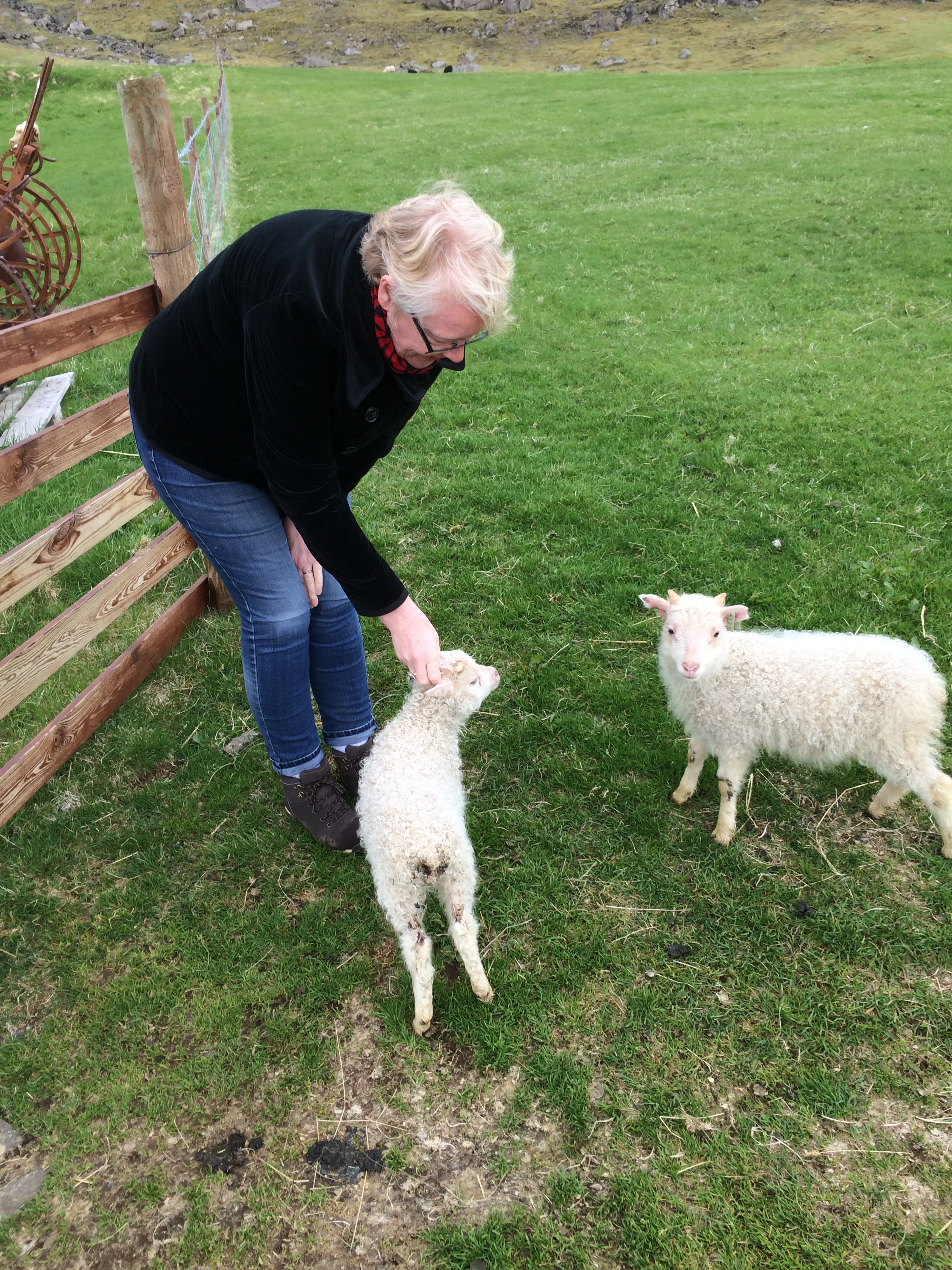
Pet lambs at a farm we stayed in - aaahhh!

Pet lambs at a farm we stayed in – aaahhh!

I think our trip all in (flights, 4 nights hotel for 2, car hire, petrol, food) will probably come in close to £1,500 with the hotels accounting for half of that.  On the upside, the national parks, waterfalls, geysers, etc are all free to visit and the hotel price always includes a decent-ish buffet breakfast.

Steam rising from the ground everywhere at Namaskard

Steam rising from the ground everywhere at Namaskard

6 Take binoculars.  Even if you aren’t a birder there are so many birds to see that you’ll want to be able to see them properly.  I regret not having an Iceland bird book or app with me as I was unable to identify half the birds we saw and am about to start trawling through retrospectively.

Puffin outside burrow at Latrabjarg

Puffin outside burrow at Latrabjarg

At this time of year the seabirds are all present (including the puffins of course) and there’s an especially diverse mix of waterbirds & ducks on the rivers and lakes.  Great for spotting Harlequin ducks surfing on the river at Laxa and Red Necked Phalaropes everywhere around Lake Myvatn.  A real treat.  There’s an odd lack of other animals.  Didn’t see a single rabbit or hare, there are hardly any cows or chickens and most livestock is sheep or ponies – the ponies in every combination of colour & hairstyle.

7 If like me you love your tea, take a travel kettle and tea bags.  Only 1 of our 4 hotels provided a kettle.

Stand back as she blows! - Geysir

Stand back as she blows! – Geysir

8 Don’t put your fingers into the boiling water rivers coming from the Geysir.  There are signs everywhere telling you the water is 80-100 deg C.  My husband still had to test that for himself however…

9 Be prepared to be amazed – you’ll see sights you’ve never seen elsewhere.  Bright blue icebergs floating in a river surrounded by seals where a glacier meets the sea (Jokulsarlon), spouting geysers, boiling bubbling mud, heat rising up out of the ground, weird man made piles of stones, waterfalls everywhere you look, cliffs made of lava that looks as though it set yesterday, a land that still seems to be forming in front of your eyes.

10 Do go out in the middle of the night – just to make sure it’s still light.  I did – and it was.

Future e-learning trends – my top 3 predictions – or Learning the Norwegian Way

Our fully engaged REN Norge Showday audience

Our fully engaged REN Norge Showday audience

Yesterday I joined the Research & Educational Network Norge e-learning Showday in Oslo to deliver a 30 minute talk on e-learning trends. The event was organised by Innovasjon Norge and hosted by DNB bank. Yes – a bank. But a bank unlike any other I’ve ever been in. It’s in the centre of Oslo and it’s a new banking headquarter housing over 4,000 employees who’ve been brought together under a single roof from 17 previous locations.

Even the crockery is cool in this Bank

Even the crockery is cool in this Bank

But wait – there’s more. In Norway citizens embrace their banks and they also seem to like their banking colleagues. Banks are seen as a positive part of the economy and they do useful things. The DNB HQ in Oslo feels more like a high end accelerator. One that’s been thoughtfully designed & then kitted out with gorgeous furniture and sculptures and artworks. A big bright café in the centre where employees and visitors congregate to chat and have coffee or lunch. Cool Scandinavian egg chairs, acres of blond wood and even hip but matter of fact Figgjo Flint crockery.

Millions of electric candles in a tiny dark mirrored room

Millions of electric candles in a tiny dark mirrored room

Some whimsy is provided in the form of a small mirrored room containing an installation from a Japanese artist. Our host, Trond Markussen, kindly closed Ollie Gardener & I in there & waited for us patiently outside. We stood in hushed anticipation in the darkness and oohed and aahed as thousands of electric candles lit up.

The conference was affordable to attend (about £100). It started at 8am and finished about 2.30pm (Norway has an early start culture with many people beginning their working day at 7am). The programme was a mix of keynotes from the sector, including mine, and 5 minute pitches from the 20 or so companies with exhibition stands in the room. Everything was completely relevant to the theme of the day and we finished up with a quick telephone vote from everyone in the room for their favourite pitch – no judges or elaborate application processes required. Our hosts announced the 3 winning companies and presented them each with a bottle of wine (a valued prize in Norway given the cost of alcohol!) The day managed to be both educational and commercial and the 180 attendees stayed in the same lecture theatre all day. No comings & goings. No-one left early or rushed off after they’d spoken. The exhibition stands were around the perimeter of the lecture theatre and we had lots and lots of short networking breaks. Everyone was chatting to each other and it was hard to tell who was buying and who was selling. People clearly enjoyed catching up and chatting with colleagues they don’t often see in real life – Norway’s a big and sparsely populated country (it’s roughly the same size as Italy but with a population smaller than Scotland). The big corporates (IKT Norway, Statoil, Evry) stopped by with the startups and SMEs and it all felt collaborative rather than competitive.

Passionate presenting from Ollie

Passionate presenting from Ollie

I was there with Ollie Gardener of Noddlepod, a social learning platform that I recently angel invested in. It’s like a Slack for learning communities. Another member of the Noddlepod team, Charles Jennings, was also in town. Charles was addressing a group of senior HR Managers about 70/20/10 in a different event two buildings away.

The loft in Oslo where we're holding Noddlepod's 3 Sept event

The loft in Oslo where we’re holding Noddlepod’s 3 Sept event

All of us will be back in Oslo in September because we’re hosting a free networking event that Charles will be speaking at on 3 September. You can register to attend via the link here

I talked about where I think e-learning is going next and my slides are shared below. I finished up with my top 3 predictions for learning over the near term – 24 months – any further out than that is too hard to predict in the EdTech space with the speed technology is moving at. Here they are for anyone that’s interested:

  1. A move from MOOCs to SPOOCs with some new and interesting business models emerging and learning & development teams shifting to become profit centres instead of cost centres;
  2. A dramatic increase in the use of wearables and the Internet of Things (smart watches, smart helmets, iBeacons to be everywhere – send away for your developer kits now!);
  3. Much more usage of mobile and social plus the rise of niche Communities of Practice (check out Learning Pool’s new open source authoring tool Adapt to create beautiful mobile ready content, take a look at Noddlepod if you’re a corporate university or business school, have another go with Knowledge Hub if you work in or around the UK public sector).
With the wonderful women who translated my rambling first from English to Norwegian and then to sign language - wow!

With the wonderful women who translated my rambling first from English to Norwegian and then to sign language – wow!

I nearly didn’t go on stage at all because the two very lovely women who were doing sign language interpretation of all the presentations on the day warned me that I’d better have prepared a well structured and clear talk…I kept them each in view in the corner of my right eye and as long as I could see their hands moving I knew I was doing ok.

Well earned pints for Ollie and Charles at the end of a productive day

Well earned pints for Ollie and Charles at the end of a productive day

So what else did I learn in my 2 days in Norway? Citizens truly have a real say in what happens in their country & democracy can actually work, breakfast is the finest and most lavish meal of the day, big Norwegian corporates do seem to genuinely care about corporate social responsibility and many of them see EdTech as a way to bring about real and fast change in the 3rd world by educating and upskilling children and young people, a pint will set you back about a tenner, public transport can work smoothly, airlines can provide free on board wifi if they choose to, Oslo is guarding its green belt fiercely by creating satellite towns linked to the capital by underground trains, being next to water breathing fresh air and seeing lots of trees is good for the soul, oh – and Ollie Gardener is lucky enough to have very cool parents …

Thanks to Trond Markussen of DNB and Lisbeth Smestad of Innovasjon Norge for inviting me to speak & for bringing together such a great bunch of people & projects for a day. Thanks also to those lovely people who responded to my Twitter call re their favourite future learning trends – Andrew Jacobs, Denise Hudson-Lawson, Megan Peppin, Mark Smitham, Julie Dodd, Matt Walton, Mary Loftus, Joyce Seitzinger and last but not least, Steve Wheeler. Thank you all.

If anyone has any comments to make about near term future predictions on learning trends or indeed about Norway then I’d be delighted to receive them so please do comment below.

I’ve joined the Knowledge Hub project – here’s why

Imagine a virtual place where people who work in the wider UK public sector could find and network with each other, collaborate and publish, share anything, create and join expert groups. A place where a public servant or health worker or councillor or local government officer or charity worker or trustee could find and connect with likeminded people, extend their professional and personal network and improve their own career prospects and build employability currency by sharing and showcasing their work with and to their peers. Imagine if they could create public or private groups, invite their colleagues into them and start some dialogue. What if it was a place where people could also manage their business network properly and turn it into a valuable professional asset. And maybe show off a little bit about the great work that they or their organisation have done along the way.

Imagine a virtual place where as I start to type a free text question, the environment recognises some of the key words and starts to suggest to me other people in the wider public sector that I may wish to connect with or direct my question to, or offers me relevant content that I can easily squirrel away into my own private space, or offers me a “better” version of the question I’m asking along with a well-considered answer.

Imagine a vibrant virtual place that I can access from anywhere in the world and in a matter of minutes scan through all the important professional news of the day in a way that’s context specific to me.

It’s not Facebook, although it works a bit like that. Facebook is for my family and friends. It isn’t LinkedIn – good for filing away my business contacts (and great for head hunters and recruitment consultants!) but I still haven’t worked out if that’s worth it for the amount of unwanted and annoying approaches I receive. It’s bigger and works across boundaries better than Yammer. It’s an expert network, not a social network. I use it to make my own job easier and to make my organisation and indeed the sector better informed and more efficient.

Best of all it’s free to use.

The good news is that most of what I’ve described above already exists and is available for anyone to access right now. It’s called Knowledge Hub and you can join here – you can do that right now and start connecting and collaborating immediately. Everyone is welcome and there’s only one important rule – no overt selling allowed!

I’m excited and pleased to announce that I’ve joined the Knowledge Hub team this week. I’ve been aware of and closely connected to the project from the very early days when it was a seed of an idea started by Steve Dale at the IDeA, way back in the day. I used to work with some of the team members at the IDeA in the early noughties. I’ve joined them again now because I believe that the time has come for us all to pull together more than ever and work to make the public sector better able to deliver high quality services to the people we all work for and represent. Others agree with me and have joined in as well. So far we’re proud to count Socitm, Improvement Service Scotland, the Specialist Schools and Academies Trust (The Schools Network) and education research and knowhow sharing charity, Education Futures Collaboration, among our early clients.

My hope? Someone once said of me that if you cut me open, I would bleed UK local government so for me the ultimate outcome for Knowledge Hub is to build an environment and community that gives its members the opportunity to do something great for themselves and for the sector. I hope you’ll all help and support us. I’m in listening mode so I’d love to hear your views or observations in the comments below.

Three is definitely a charm – my early stage angel investments

Today’s blog is a sister piece to last month’s “Angel Investment from this Rookie’s Perspective”. Last time around I wrote about what I was looking for in early stage startup companies when I was deciding which ones to angel invest in. This time I’m going to talk about what I liked most of all about the three startups I ended up selecting and investing in.

Before I begin, let’s recap on what my motivations are for angel investing in the first place. All angels will no doubt have different motivations. I am excited by the idea of putting something back in terms of helping some new early stage startups get moving. I wanted to use some of what I’ve learned starting and scaling my own businesses in the past to help a small number of other people get through their early growth stages less painfully than it was for me. After some thought in summer 2014 following my successful exit from Learning Pool, I reached the conclusion that I didn’t want to start another new business of my own and I knew I definitely didn’t want to work for someone else as a bog standard gun for hire (much as I enjoyed my 4 month sojourn in 2014 working with the vInspired Task Squad team – they’re doing really well – check them out) but I did want to carry on working.

This made the quest easier for me as I then knew that I was looking for companies where I could add value with some hands-on involvement and I also knew then that it was important for me to pay more attention to the founder/founding team as I was going to be working with them for the medium term. Let’s face it, in a startup the team or founder is far more important than the idea – ideas are ten a penny and most startups do pivot or at least swivel a little.

One surprising thing – I haven’t invested as part of any formal angel syndicate or group. I really thought I would but it hasn’t happened that way. That topic alone is probably worthy of another blog.

So what and who did I choose? All three startups are cloud based online platforms (a no brainer for me now that I come to think about it!), two of the three founders are female (this makes me very happy), all three founders share a number of important qualities and despite their differences they’re remarkably similar, two are companies based in England & one is in South Wales (disappointed that I didn’t find anything in Northern Ireland or Scotland this time around), all are involved with changing the way people do things – communicate, learn, organise. All three really care about their team culture as they grow and whilst they’re all focused on generating revenue and making profit, they all know that there’s more to life than making money. Finally, all three have a capacity to really scale quickly and without adding huge resource into the team.

First on my list is RunAClub headed up by fab founder and CEO Sally Higham. RunAClub has everything you could possibly need to run any sort of club or group, all simple to use, neatly packaged and stored in the cloud. Beautiful. Our customers so far are national sports organisations, local authorities, charities, community groups and individual clubs/groups. What do I like most about RunAClub? It’s such a useful product, everyone we speak to loves it and it’s so clearly scaleable. I love most things that truly save people time whilst remaining affordable and easy to use. As an investor, I like that RunAClub is scaling fast in its chosen core market but I also like that there are numerous other verticals for us to move into. An unexpected but very welcome bonus along the way has been that a really old friend has co-invested with me and this gives me a chance to work with him again.

RunAClub team last month in Sally's kitchen in Wiltshire - you don't have to be blonde but it helps!

RunAClub team last month in Sally’s kitchen in Wiltshire – you don’t have to be blonde but it helps!

I first saw Sally pitch at a Clearly So Big Venture Challenge event last summer. During her presentation she said – “what I really need in order to maximise RunAClub’s opportunity is another me” and that resonated strongly with me because I’ve been in that position so many times myself – so when she’d finished pitching I went straight over & introduced myself.

The RunAClub team is the liveliest and most can-do bunch of people that I’ve met in a long time. Their enthusiasm is infectious and I’m genuinely looking forward to spending time with them, growing a successful and valuable business.

My next is Captive Health. I love that I’ve known the founder Andrew Cockayne for years. He used to be one of my Learning Pool customers many moons ago and I’m so pleased that he’s become an entrepreneur himself and also that I can continue to work with him. Captive Health is the most mature of my 3 investee companies and in truth is more of a scaleup than a startup.  The company provides the health sector with a platform that allows richer interactions with and between their staff and their patients. Staff can access information and network within their teams when they’re on the move (only 40% of people working in a hospital have access to a desktop). Patients can use Captive Health to provide feedback and information about their choices and preferences. Hospitals love the products and we already have five as customers with many more in our pipeline.

At the recent PEN Awards in Birmingham with Andrew Cockayne & Leena Shaw of Captive Health & one of our progressive customers, Jo Wood of Ipswich Hospital

At the recent PEN Awards in Birmingham with Andrew Cockayne & Leena Shaw of Captive Health & one of our progressive customers, Jo Wood of Ipswich Hospital – I’m working on their footwear!

I heard Simon Stevens, Chief Executive of NHS England, speak at last month’s e-Health Week 2015 Summit. His opening gambit was “No industry has ever re-invented itself on the scale that the NHS needs to over the next 5 years without smart use of technology”. Captive Health’s product set offers the NHS some affordable tools with which to get ahead in dealing with their huge challenge and I’m pleased to be part of that mix.

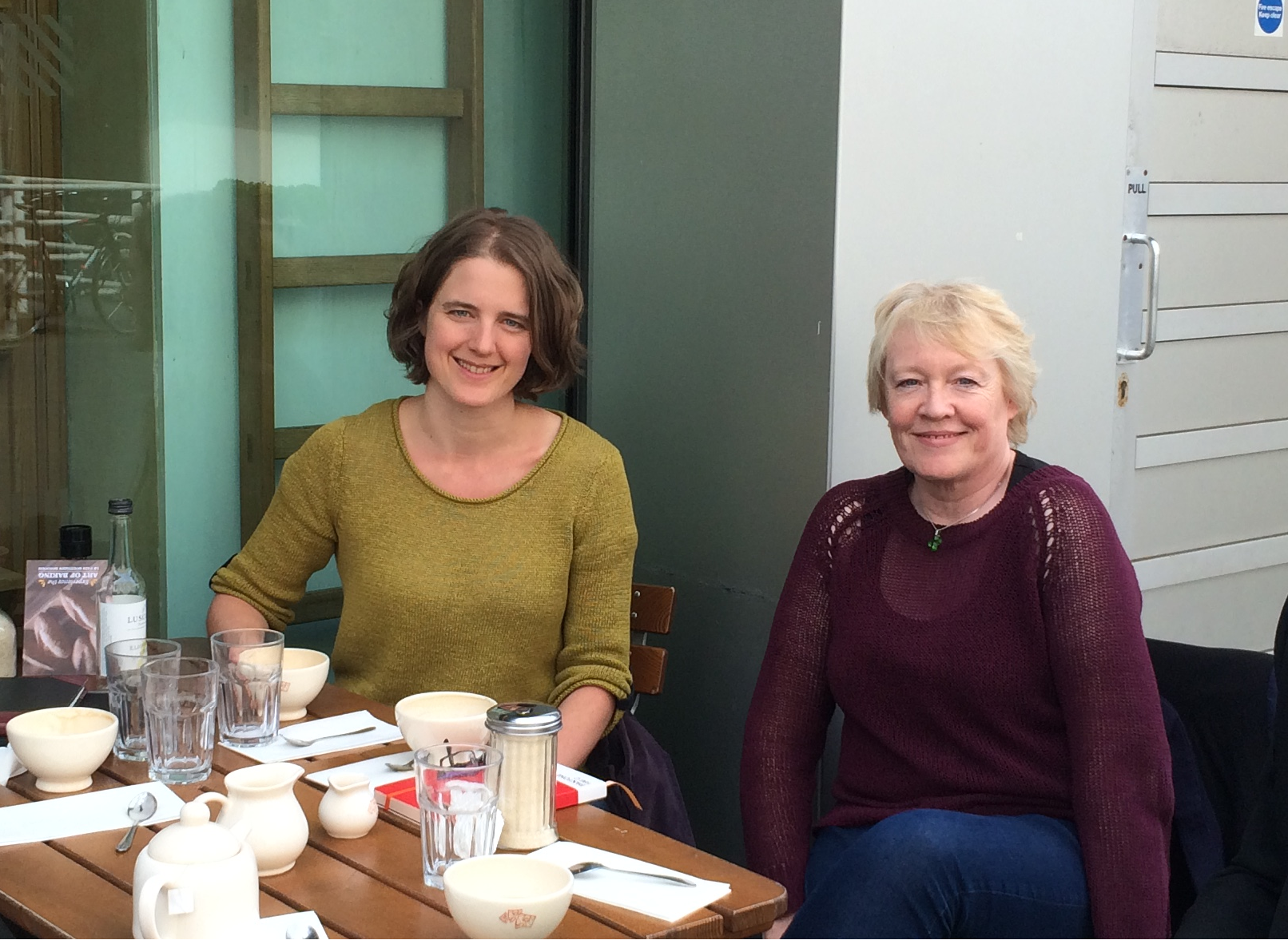
Last but not least is Caerphilly based Noddlepod. Noddlepod is like a Slack for your learning communities. It’s a social learning platform that allows you to easily share your files and search for resources with the same degree of immediacy and familiarity. I met founder Ollie Gardener at a tech event in Buckingham Palace hosted by Her Majesty the Queen. Ollie was wearing Norwegian national dress. You can guess the rest. We’re very grateful to Neil Cocker of Cardiff Start & Matt Johnston of Digital Circle for allowing us to meet!

Noddlepod is my earliest stage investment of the three but it’s grown out of a number of years of considered reflection by the founding team on where learning is going next and Ollie has corralled some very experienced and well know global learning experts onto her Board including our Chairman Charles Jennings and fellow non exec Nigel Paine. Edtech continues to create frenzied excitement in the investor space and we’re encouraged (!) by the recent $1.5bn sale of Lynda to LinkedIn. Great that LinkedIn now has access to all that content but I wonder if they’ve thought about how to deploy it coherently to their millions of users?

With Ollie this month - outside my London Southbank "office" - having tea & more tea

With Ollie this month – outside my London Southbank “office” – having tea & more tea

Until LinkedIn or similar comes a-knocking, we’re focused on bringing Noddlepod to corporate universities and business schools worldwide. I love most that as a Norwegian, Ollie thinks way outside of the four walls of the UK in her growth plans and that she has a number of overseas investors and a pipeline already full of European opportunities.

So that’s my three. Exciting times. I’m certain I’ll prove all those people who advised me against making early stage angel investments wrong. As always I’m interested in hearing your questions, comments, observations. Check us out. Startups always need a helping hand and you all know it makes sense to work with small, growing businesses jammed full of bright, ambitious people with great tech – it helps our local economies and it keeps you sane.

Angel investment from this rookie’s perspective

Beautiful carved wooden angel - photo by Wolfgang Moroder

Beautiful carved wooden angel – photo by Wolfgang Moroder

“I saw the angel in the marble and carved until I set him free” – Michelangelo

Last month I made my first angel investment. I know many of my blog readers are entrepreneurs and startups and some of you are or will be seeking angel investment, so I thought it might be useful/interesting for me to jot down (from a poacher turned gamekeeper type of perspective) for you a few of the choices I’ve made along my own personal investment journey and why – in case it helps you.

To set the scene I’ll start with why I’m doing a small number of early stage angel investments in the first place and what my criteria have been. My main objective was to eventually select a handful (my final number is three) of early stage startups where I liked the idea but more importantly liked the founder or startup team. My motivation is to use some of what I’ve learned starting and scaling my own businesses in the past to help a small number of other people get through their early growth stages less painfully than it was for me. If I make any money along the way, I’ll celebrate that as a bonus. Making money is not my primary objective – which is lucky because many of the wise heads I know have gleefully warned me (a few of them several times over) that it’s impossible to make money by investing in early stage startups.

A couple of other bits of info make up the full picture. Although I’m a member of a couple of formal angel networks, I haven’t invested through them or as a part of any of their syndicates. So far anyway.

Finally, the startups had to be somewhere on the spectrum of my own areas of interest so that I can add value. This inevitably means software, X as a service or platform, community, scaleable, public sector, always something to do with people and how they can save time or money by collaborating, learning from each other or working together.

I’ve been talking to startups for years. It’s a natural part of what all entrepreneurs do. For me the night out that will always trump all others is one where I can watch other startup entrepreneurs pitching. I just love that initial rush of thoughts about another person’s ideas – working out the angles on the business models and the commercials…seeing if I can spot some opportunities that they’ve overlooked. As an aside, I love it even more if it’s something I’ve considered doing myself in the past but haven’t been able to work out the commercials or the logistics and then someone else manages to do that (for example, Northern Irish startup Send My Bag).

As a seasoned and successfully exited entrepreneur, people seek me out anyway for all sorts of reasons. Because of this it was fairly easy for me to start about a year or so ago to assemble a long list of 20 or so potential investee companies and kick off an initial conversation with the founders as a way to start my selection process.

This is what I was considering:

• Do I like the product or product idea and am I convinced it can scale?
• Would I buy it myself for my own (theoretical) organisation to use?
• Is the founder credible, articulate, stable and sensible but with a dollop of sparkle?
• Do I like them enough?
• Can I see myself working with them over the next 3-5 years?
• Are they resilient enough to keep things moving forward when times get tough and do they have the grit to sack bad hires quickly and stand up and fight for themselves and their company when they need to?
• Are they well-informed about their competitors and the way the market is moving?
• Can the founder front the business; are they likeable and convincing without being arrogant and smartass?
• Is their company valuation reasonable and realistic?
• Do they have a good overall grasp of what their next 2 years looks like in terms of back of the envelope targets, resource requirements, funding, effort needed, team, etc?
• Is the founder generally on top of their workload and easily able to articulate key messages and information?
• Are their targets and forecasts reasonable or complete pie in the sky?
• Can I clearly see how I can add value to both the founder and the company?

It took me a while to put the above list together as I’ve never written it down before. In case you’re wondering – yes – it is more or less in order of importance to me. I did say this blog was going to be about my own personal investment journey…

Only companies that passed the first 2 questions made it onto my long list of 20 companies in the first place and then between June and December last year I whittled those original 20 down to 3. I guess where it gets interesting is how I did that. I’m afraid it isn’t scientific for anyone who’s expecting a checklist and a spreadsheet.

A few fell at the valuation hurdle. If all you have is an idea and you don’t have any product built or any customers, your company in my eyes is not worth £1m. Simple as.

A few others fell by the wayside because of the founder. The trick here is to keep meeting with them until you’re either convinced that they’re the real deal or until they let their guard down and expose themselves to be anxious, needy, deluded, arrogant, ego-driven, greedy, selfish, brattish, indecisive or any of the many qualities you as an investor don’t want to see in a startup CEO or leader.

Some over time I just had a bad feeling about, or something told me that the founder wasn’t 100% honest – I could just feel it wasn’t good when I scratched the surface.

Others I lost because a few months in the product was no longer holding up or it became apparent that the founder wasn’t able to move at the pace required to get to market within their window of opportunity.

A couple went because the founder had more than one focus and it became apparent that they were spread too thin and weren’t giving any of their projects the attention they deserved.  A couple more because the founder knew it all and wouldn’t listen to any advice from me or from anyone else.

And so I was left with three – which was the number I was hoping for in the first place. Two of “my” founders are female and one is male. They all share a number of important qualities and despite their differences they’re remarkably similar.

This blog is part of a short series and I’ll write about the companies themselves next time around.

If you have any questions please ask them in the comments section below and I’ll do my best to answer.

Swingin’ London

Stokey Lit FestThis morning in the midst of sorting out my horrendous paperwork backlog I stumbled across a flyer I’d saved from last year’s Stoke Newington Literary Festival.  It was for a screening of the excellent “How We Used To Live” film directed by Paul Kelly, narrated by Ian McShane and with a “swingle-y” soundtrack from St Etienne.  It’s a collection of BFI footage from the years 1950-1980.

I really enjoyed the Stokey Lit Festival last June.  We went for the entire 3 days.  I’d strongly recommend attendance if you’re in London this June, dates this year are 5 to 7 June.  There’s a real eclectic mix and the stuff I liked best ranged from a talk about our relationship with numbers to some crazy science fiction authors discussing how best to make money from publishing short e-books to a conversation with iconic cartoonists Steven Appleby & Martin Rowson to learning about Georgian London from Lucy Inglis to listening to dub poet and legend Linton Kwesi Johnson.  Really good fun and hanging out in between in Stokey’s hipster coffee bars & restaurants with the rest of the truly bohemian crew.

Back to the film.  There were a few things that really struck me from watching old footage of the 60s and 70s especially as that was the era I grew up in.  I wrote them down on the back of the flyer before leaving my seat at the screening and I so enjoyed reading them again this morning that I thought I’d share them with you.

Sid & Johnny from The Sex Pistols Experience at the 100 Club Feb 2015

Sid & Johnny from The Sex Pistols Experience at the 100 Club Feb 2015

Incidentally, as a person who usually looks forward rather than backwards I’ve just realised that in the course of the last week or so I’ve been indulging in a ridiculous amount of nostalgia wallowing as I’ve watched the excellent BBC4 documentary about Joy Division & Ian Curtis, seen a Sex Pistols tribute band at the 100 Club and last night I saw Good Vibrations.  I don’t know why that is.

Now that's what I call a Mini

Now that’s what I call a Mini

Here’s my list – please, please add your observations in the comments section below:

  • Minis were small cars, not great big things
  • Police cars were also small
  • People were thinner – but they had terrible hair, skin & teeth
  • People were either young or old – there was no-one in between
  • Men went to their work to do physical labouring in proper trousers and jackets
  • Mickey Most went out jogging in a brown shirt & trousers and his office shoes
  • Punks really were different than anything before or since
  • Our streets were thinner
  • The Tube was just as busy and everyone looked just as p’d off commuting
  • The Festival of Britain looked incredible; St Thomas’ Hospital recorded 2 baby girls named “Festival” and one baby boy called “Skylon” (I wonder where they are now and did they change their names?)
  • The Queen looked amazing
  • Tower blocks looked awful – even when they were new
  • Industry was so manual – there’s footage in the film of men operating a wrecking ball and rows and rows of men in teams physically lifting railway sleepers as part of the railway transformation programme
  • All the London landmarks are recognisable (Big Ben, Tower Bridge, The Monument) but there are tiny, almost imperceptible differences
  • Cars all looked different instead of being identical silver boxes
Glamour-tastic taste of the 70s

Glamour-tastic taste of the 70s

Reading that again this morning made me remember the fun of rushing home from school in the 1970s, desperate to catch Marc Bolan & David Bowie in full-on glam rock paraphernalia on British tv at teatime.  Glorious.

Catch that film if you’re old like me and want to experience those strong waves of nostalgia from things long past and see you all at the Stokey Lit Fest in June.

Startup recruitment – reject show-offs, clowns and mavericks …

Bryan Keating - possibly the world's best Chairman

Bryan Keating – possibly the world’s best Chairman

From the warmth of my temporary California base this week I noticed with interest that successful scaleup Futuregov is advertising publicly for an Executive Chair. Why with interest? Well really it’s because these types of appointments are so rarely advertised in a scaleup or SME.

This got me thinking about small business recruitment in general and what a dark art it is. Staying with the Exec Chair campaign for a moment, I can understand fully why Carrie & Dom are going down this route – it widens the selection pool beyond their own (extensive) networks and it’s a more transparent, open and fair process. But will it get them the right or best candidate? I’m not sure. Inevitably, processes that open some doors also close others.

In my world, the more usual way to bring someone into your small business as Chairman or a NED is to go out to your network and then make direct approaches to people, or a person, that you think may be suitable. A number of conversations take place behind closed doors and the “target” individual will make a decision based on any combination of the following and more – do they like your business, do they like you, how much else have they got going on right now, does your opportunity complement or conflict with their other current activities, can they see clearly how they will add value, what are you offering them, how’s it going to look on their own cv, are your exit aspirations linked to their available forward timescales, etc

Many of the sorts of people that I might approach if I was seeking an Executive Chair would never participate in a public recruitment process. They wouldn’t wish to be open and transparent in their dealings or intentions and they simply wouldn’t compete in a public way with others – definitely not. So well done Dom & Carrie for being brave enough to run a process that rules those people out and good luck with finding the right person.

There’s a wider issue here and one that I’d never really thought about much – despite having spent an awful lot of my own time during the past 10 years actively recruiting people into my own teams. At a dinner in Dublin last year I found myself sitting next to the head of a very, very large software company’s 2,000 person development team. We chatted away and inevitably the conversation turned to how difficult it is for a small business to recruit decent tech talent. My dinner companion at this point happened to say to me that he has a rule whereby he never recruits people via recruitment agencies or headhunters. Never. No exceptions. His reason for this was simple and straightforward. He believes that only second rate candidates use their services. He recruits only via his company’s new graduate programme and he sometimes interviews people recommended by others in his network or team. His further rationale when I challenged him a little on this was that he may occasionally miss a good person in this way, but the amount of time he saves by not bothering with or interviewing “bad” candidates was considerable and the trade-off was worth it. It also saved him from the nuisance factor that recruiters & headhunters introduce into your business – once they’ve placed a candidate with you they continue dialogue with your employee so that they don’t miss an opportunity later to make more commission when they can persuade that person to move again.

Later on I thought about my own career path and realised that I’ve only ever formally applied for two out of the numerous jobs I’ve had in my working life – once as a new graduate (I got my first job by applying via an advert placed in the Guardian) and again when I was moving to a new country (Northern Ireland in 2000) and didn’t have an existing network. Everything else I’ve ever done has come to me through my network.

Recruiting the right people into your team is the hardest job of any startup or scaleup CEO. I don’t care what any recruiter or HR person says about this, recruitment into your team is a nightmare and often it’s completely random as to whether or not the appointment you make turns out to be a success. Drawing up endless criteria and scoring lists of candidates against them? For the most part a complete waste of time and energy and it turns the process into something akin to the very worst excesses of procurement. Recently I’ve heard of a couple of people in my own network who’ve been encouraged to apply for vacant posts by the Chief Executives of those organisations. Both have gone on to apply & attend interview and both were unsuccessful. What’s that all about? Were they being used as stalking horses by unscrupulous Chief Execs wanting to make up their interview numbers or was it that the panel had a scoresheet that had to be adhered to on the day and therefore the Chief Exec was over-ruled or outvoted and their preferred candidate ousted by someone who happened to interview better on the day. (Rookie startup CEOs – this is something else to definitely watch out for – the professional interview performers – great at interview but by the end of Week 1, you realise with a sinking heart what a dreadful mistake you’ve made.)

Instead, satisfy yourself in the first 5 minutes that the candidate really wants to work in your organisation for the right reasons and has a clear view of where and how they can add value. Also, reject all show-offs, clowns and mavericks, no matter how interesting or compelling they seem. Believe me – all they will bring to you is a huge time sink and disharmony in your team.

For me, this is an interesting topic because despite having built world class startup teams several times over on a shoestring, recruitment is something I’ve struggled with over the years. I’ll readily admit that some of the worst and most personally painful mistakes I’ve ever made in business have been recruitment related.

Interested to hear your views, hints and tips for others on small business recruitment so please do share in the comments section below. The photo above is of Bryan Keating, the best Chairman I’ve ever worked with or for. Although having said that I’ve always loved the story about how the founders of the Innocent drinks company used to employ a 50p piece in the early days that they referred to as “The Chairman”. They flipped it for a simple heads or tails decision when required. I don’t know if the story’s true or not but certainly food for thought Dom & Carrie?

Going the extra mile…or why the little things in life really do matter

Extra Mile - Palm Springs style!

Extra Mile – Palm Springs style!

Do you remember this poem from your schooldays?

For want of a nail the shoe was lost,
for want of a shoe the horse was lost,
for want of a horse the knight was lost,
for want of a knight the battle was lost,
for want of a battle the kingdom was lost.
So a kingdom was lost—all for want of a nail.

I was fascinated by this story as a child and it’s a theme I often return to when I think about startups or small businesses. As an aside, the idea of a small issue leading on to something much bigger lends itself to many aspects of life outside business too – but more about that later.

In my mind, there are two ways that smart small businesses elevate themselves above basic bog-standard delivery and every new business struggles with either or both. Those organisations that can get these two things right effortlessly, consistently & with grace are the ones most likely to succeed.

The first part is about making sure that nothing important gets dropped. I know there’s a saying in startup land – “if the wheels don’t come off, you aren’t going fast enough”. Ignore this sort of silly “bro” culture nonsense when you’re starting your business – startup chaos is never fun from a customer perspective. If you can get efficient delivery right with some consistency in the early days as you expand beyond your founder team and early doors customers then you have a chance. It’s always very difficult to instil your founding team’s customer service ethic into your employee team. Fact. You can devise methods of measuring and monitoring customer service standards until the cows come home, but in my view the better way to tackle this when you’re starting out & beginning to expand and grow your team, is to focus on bringing the right people on board in the first place. People who already share your values and have the right mindset.

It’s ok to make a rare exception (maybe someone completely new to the workplace?) but really take care with your early recruits as those first team members are the foundation on which you’ll build out the next layer as you expand and then the layers after that. Never, ever employ someone who in the first 5 minutes of a job interview can’t articulate to you why they really want to work in your business and what specific value they will bring to you. That “better a hole than an xxxhole” statement is very true and one that I wish I’d paid attention to a bit more closely myself on several occasions – because you do really know in your gut whether or not someone is right to bring into your team. It’s all about creating the right sort of culture in that first wave of team members. If you get this wrong you are lost. In the course of my career, the most difficult customer issues I’ve ever had to resolve have been minor situations made worse by lack of communication or people in my own team lying to customers in order to cover their backs.

Also – everyone screws up from time to time. This is ok. The important thing is to learn as a team from mistakes made and to fix things for your customer as quickly and painlessly as possible for them. If you get this bit right, you could find yourself in an even better position with your customer because they’ve seen how you behaved in a time of adversity and they will admire you more if you’ve been honest.

The second part of this blog is more fun – once you’ve figured it out. What does “going the extra mile” actually look like in your particular business? I once heard Doug Richard say “any conversation with a customer is too short” – and he’s absolutely right. Without knowing why your customers buy from you instead of anyone else and which bit of what you provide they value most it’s pointless trying to go any extra miles as you could be wasting your time providing them with something that doesn’t really delight them and may even annoy them. U2’s music for example!

Everyone knows that startups have to over deliver. It’s one of the ways to get your first few precious customers – the ones that will hopefully go on to become ambassadors for you. Subsequently, stories about delivering customer delight and the resulting karma are legendary in entrepreneur circles. Hearing these tales from other entrepreneurs is one of my favourite pastimes and in my anecdote kitbag I have countless stories of huge contracts won on the back of a small act of kindness delivered at some point in the past. One is about a sales guy getting home at night & receiving a call from a school he’d just delivered some computer kit to that day. The teacher called him because he was delivering a presentation the next day & the printer cable he needed was missing. The sales guy didn’t complain, quibble or argue – he simply grabbed a cable from the office, turned the car around & drove the 70 miles back up the road to take it to the teacher with good grace. Years passed and the small computer company had pivoted & grown into something much bigger and different. The teacher changed jobs too and when he was looking for a supplier to provide an airport security system, he went back to that same sales guy.

My own favourite is a Learning Pool story. Sam Barbee & I went to a large and remote unitary local authority to deliver a lengthy sales presentation to a big group of people in a most unsuitable room. It was one of those rooms used for computer training and many of the people were hidden from view behind computer screens. We didn’t know anyone in the group and introductions weren’t made. The council had recently become a unitary authority, swallowing up the district councils in the process. Many of those in the room had been through long drawn out rounds of local government restructuring and were feeling fragile and bruised. Sam & I soldiered on with the presentation. Suddenly a woman at the back got to her feet and announced that in her previous role she’d been a Learning Pool customer in one of the district councils. Without waiting for permission, she launched into a tale about how she’d been working one day as administrator on her Council’s learning environment and had got it into a bit of a muddle. Tired and fed up she went home. Next morning she came into work with a feeling of trepidation, knowing she had to undo yesterday’s mess. She switched her computer on and immediately realised that her Learning Pool account manager had noticed overnight that she’d got herself into a muddle and without waiting to be asked, had gone in & fixed it for her. She finished off by saying that in all her years of working in local government she had never worked with a more customer focused supplier than Learning Pool. It was incredible. Sam & I could have kissed her. The atmosphere in the room changed in a heartbeat and 6 months later, after jumping through all the usual procurement hoops, the contract was ours.

But where do you draw the line? And how do you know what your own extra mile is? This is the tricky bit. As a small company you have to find ways to delight your customers that don’t eat too heavily into your margin – but you can only do that if you know your margins on your various products and services and the dependencies between them. So – know your customers and know what they want from you, know your margins and be aware across your team of where you have a bit of space to give a bit more. Delivering the extra mile doesn’t have to cost you a lot of money but you do need to give this some thought. If you get it right, it will pay you back in spades and you’ll sleep easier at night. A good start is to make a vow never to nickel and dime your customers from Day 1 and to always extend the same high level of courtesy from everyone in your team to everyone you deal with – no matter who they are.

I’d like to hear any of your stories about instances of a small act of kindness in business paying back many fold so please do share in the comments section below.

On a personal note, I keep a loose mental tally on favours I’ve done in business for others and favours I’m owed. I can’t help it – it’s the accountant in me wanting to classify everything in life into debits and credits. Don’t worry – I haven’t started noting it down in a ledger yet. I try to keep it so that I’m in credit with everyone in terms of favours I’ve done for them. I’ve done this all my working life and it’s only ever led to good things happening for me – and it means that when I really need a favour or need someone to pull me out of a hole, there are usually lots of people I can ask.

Why are charities struggling to build and launch digital products?

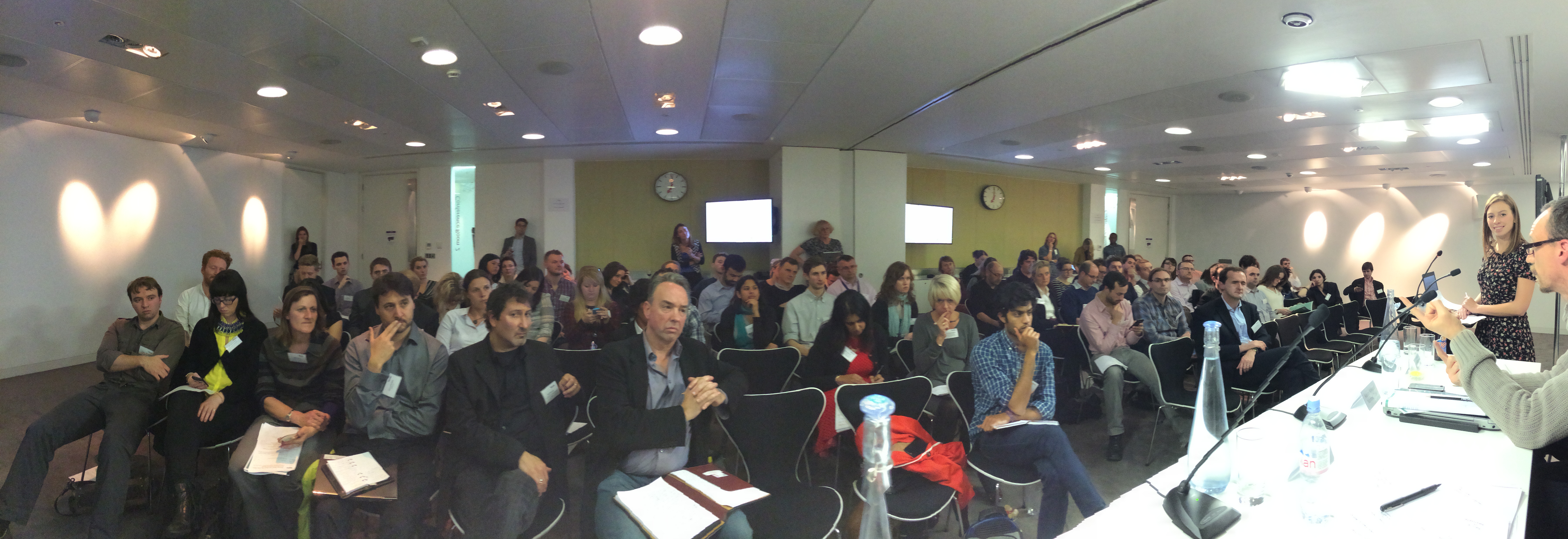
NESTA audience

NESTA audience

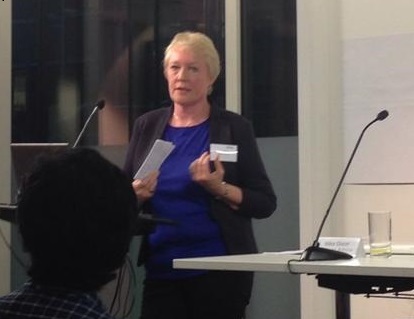
This week I was privileged to keynote at the NESTA Impact Investment team’s Going Digital launch with NESTA’s Katie Mountain and Isabel Newman. Katie & Isabel asked me to speak because of my fairly unusual perspective – a tech entrepreneur who’s actually worked recently on a revenue generating digital project launched by an established charity. Earlier this year I was lucky to spend 4 happy months at vInspired, working with Sam Sparrow, Hannah Mitchell & Damien Austin-Walker getting awesome microworking platform Task Squad finessed and launched.

This blog covers the key elements of my NESTA talk without the personal anecdotes and side stories I included on the night. I should also just add a point of clarification here. This blog is about charities/CICs/social enterprises launching revenue generating digital products and services; it isn’t about making charity core business more digital. You won’t be surprised to hear that I have a view on that as well, but that’s for another day. It’s also not about my specific experiences at vInspired – it’s more generic observations across the whole sector. I’ve been a charity trustee myself for well over 10 years.

NESTA's Katie Mountain

NESTA’s Katie Mountain

At first glance, established charities appear to be ideal environments from which to launch digital products. They are crammed full of bright people with tons of good ideas, despite what they say they have more money to invest in product development than most startup businesses, they have a deep understanding of their target market and there’s lots of goodwill towards them, there’s existing infrastructure in the charity for the project to draw from (finance, office space, marketing & PR, etc) and they have easy access to politicians. So what’s making it so hard?

It’s unfamiliar territory…and there’s baggage

The best startups are said to be those that are “scratching an itch”. The entrepreneur sees a gap in the market and develops a product or service to SELL into that gap. The entrepreneur begs, borrows and steals seed funding and assembles a team focused on getting that product or service built and to market as quickly as possible. Money is frequently the key driver but money also qualifies early market interest in the product. Private sector success is often determined by getting to revenue in lightning speed & “owning” that niche before anyone else does. The founder or co-founders have probably had to put their houses up as collateral to raise the seed funding. The team eats, sleeps and breathes the project. Everyone’s under a lot of pressure. Often an unhealthy amount. Despite this, 80% of tech startups fail in their first 18 months according to Forbes (we’ll return to the 5 top reasons for failure at the end of the blog for anyone that’s interested). Charities simply do not work at this pace – but the private sector SMEs they’re competing against do. That’s a challenge.

The second part of this point is that the startup begins with a blank sheet of paper. For charities, many are creating digital projects to diversify away from dependence on government grants or to simply boost their income when other sources are drying up. This is a different type of driver. They are trying to do something that’s well outside their core business. They say that building a tech startup is like jumping off a cliff and assembling the plane on the way down. You need your team to be focused and on it. In charities, the digital project is often something people in the team are doing as an addition to their original day job. Working on projects part time is far from ideal and just doesn’t work. One of my conditions upon joining vInspired was that I would only undertake activities where I added value to the Task Squad project and did the things that other people in the team couldn’t do at that time. I stayed away from all-staff meetings, writing reports for trustees and so on.

The environment is risk averse…and no-one has any skin in the game

In my experience, many charity CEOs are very entrepreneurial. They’re also swamped with a million different things. Senior teams and trustees can be very risk averse. Back to that 80% failure thing – this is a high risk and uncomfortable place to be where you have to allocate money and time to something that probably won’t fly. Many charities are only engaging with this process because they are desperate to generate new income. Funders and sources of finance like NESTA, the Nominet Trust, the various social angel groups, will invest in certain projects but they expect to see the charity provide match funding, especially if it has reserves. This puts constant additional pressure on the startup project team as they are under non stop scrutiny and find themselves fielding questions from people in their own team unfamiliar with this territory and expecting to see results fast. For the people in that startup project, the “us” and “them” is very tricky. At least in a private sector startup you’re all working on the same project.

Mary McKenna

Mary McKenna

Too much investment can be a curse

In my view the best digital products start out on a shoestring budget. That way the team is more creative and it’s less of a big deal if the project fails.

A few people when they heard I was giving this talk lobbied me to say the issue for charities in building and launching digital products is lack of money and resources. I’m afraid I disagree. A large budget can lead to laziness, excessive outsourcing and maybe a “build it and they will come” product.

Back to the trustees. Often they meet infrequently but they’re the people who approve and sign things off. This doesn’t sit well with agile development, pivots and product iteration. All startup projects pivot. Getting the trustees into a place where they are comfortable with the risk involved and buy into the match funding element is definitely a challenge, but without it projects are not investor ready.

There’s a lot of meetings and governance

I understand the reasons why charities do this but it’s an additional overhead that other startups just don’t have to deal with. In an early stage private sector startup, decision making sits in the hands of one or two people. They have authority to do what they like. It’s their money. Decisions are made quickly and based upon imperfect data and information. Things move at pace. There are no reports to write, the list of KPIs or metrics monitored in the early days is short or non existent, there’s no-one else to keep in the loop, social impact isn’t measured. A charity tech project has to do all of these additional tasks on top of build and ship.

Pace is the single most frustrating aspect of working in a charity that I experienced. That and having to book meetings with people you can see across the room & who you just want to speak to for two minutes – because that’s how things are done. The structured environment slows everything down.

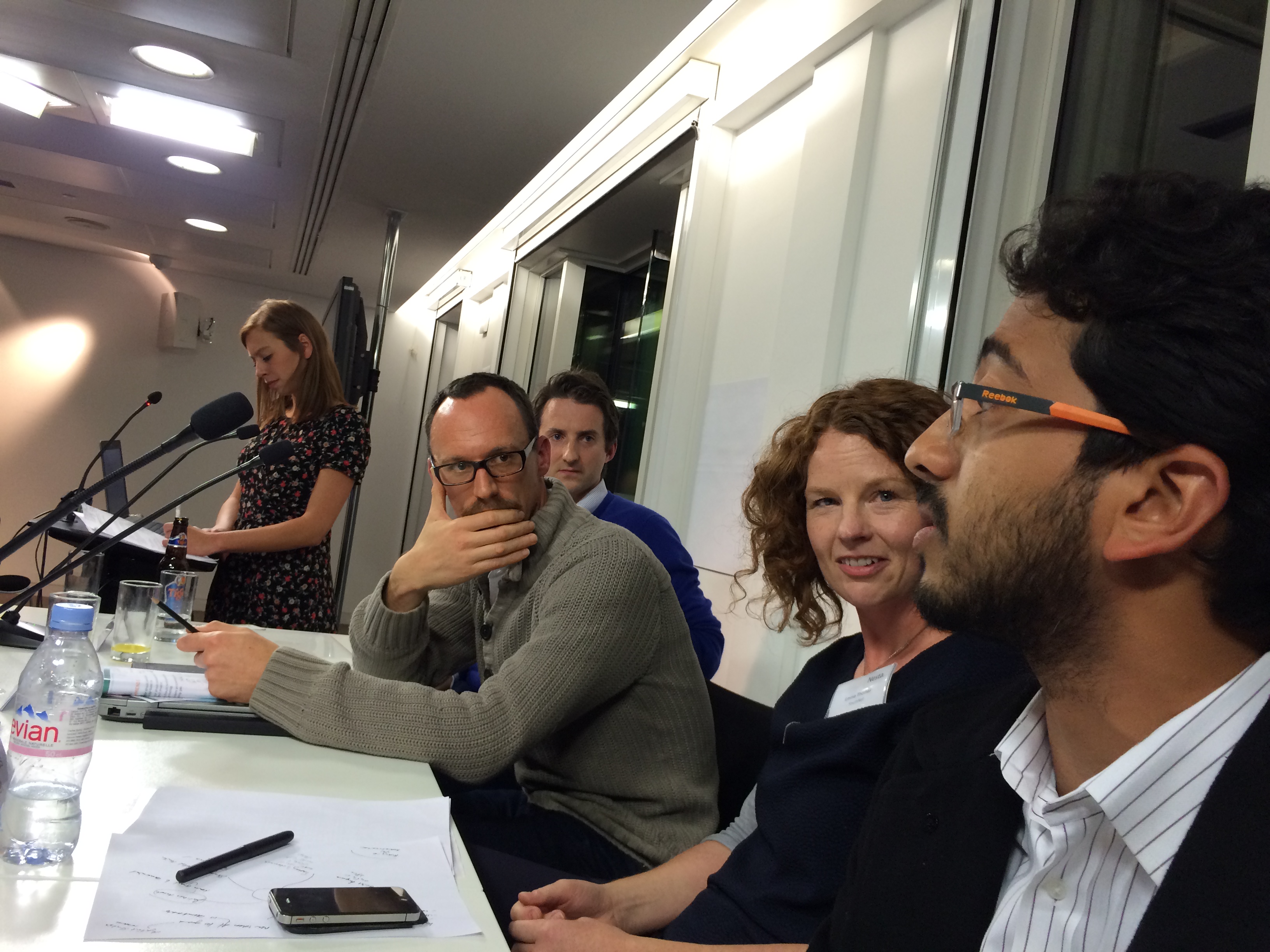
NESTA Panel - Isabel Newman, Mike Dixon, Kieron Kirkland, Emma Thomas and Shreenath Ragunathan

NESTA Panel – Isabel Newman, Mike Dixon, Kieron Kirkland, Emma Thomas and Shreenath Ragunathan

The team is any organisation’s most valuable asset

Charities have great people. Sam Sparrow who leads vInspired’s Task Squad project is one of the most impressive and talented people I’ve ever worked with in any business. There’s been a terrific drive to get a lot of charity team members onto and through accelerator programmes. What charities are bad at doing is allowing their newly trained intrapreneurs to be responsible and accountable and just to get on with things; especially with people that are considered to be “junior”. Structures are hierarchical where they need to be flatter and more matrix or project driven. In a tech startup, the most appropriate person is allowed to get on with what they’re good at within clear and agreed parameters. I’ve found that in charities, the decision making boundaries are sometimes unclear and this is one reason why the CEO and trustees end up as bottlenecks.

On top of this, there’s a Europe (world?) wide shortage of digital skills, developers and people with good commercial skills and there’s a great deal of competition to attract the best talent. Because these skills are in short supply, the people taking important decisions may not be properly equipped to do so – especially about digital. This results in poor commissioning and bad management of suppliers.

Here’s my presentation slides from the night:

I’ve probably just scratched the surface here and am very conscious that I’ve put forward an awful lot of challenges without many useful solutions. Fortunately, on the night there was an expert panel present (Kieron Kirkland of Nominet Trust, Mike Dixon of CAB, Emma Thomas of YouthNet and Shreenath Ragunathan of Google) all of whom were able to voice their own very practical advice on how the sector can improve in this space.

For anyone who’s wondering about the top 5 reasons startups fail – here they are:

  1. Lack of deep market knowledge – know your audience!
  2. Lack of USP or the ability to properly articulate it – market test your idea, work on your messaging and remember that some ideas are just bad ideas.
  3. Failure to communicate and lack of clarity
  4. Leadership issues – not so much for a charity – this one is more to do with flaky founders or personality clashes amongst co-founders that lead to the startup imploding
  5. The business model is wrong or underdeveloped – this one is KEY – spend as long as you need to getting your business model right

As always I am very much looking forward to your comments on this rather long blog. I hope we can have some useful and positive narrative about what we can all do to make this better because frankly, we really need to. If you have any questions for me about any of the above then please get in touch with me or post your questions up in the comments section for everyone to read and I’ll do my best to answer them.

Pitching for success – some lessons from the Demo Coach Nathan Gold

Nathan Gold the Demo Coach

Nathan Gold the Demo Coach

Last week I attended my first Tech London Advocate Women in Tech event at the Telefonica HQ in Piccadilly and what an event it was.  We heard from a number of interesting speakers (Nikki Watkins especially) but the highlight of the evening for me was listening to Nathan Gold deliver a 30 minute version of his longer workshop called “Pitching for Success”.

Nathan is a San Francisco based demo coach.  He spends his life getting people or companies prepared and ready for high stakes pitches.  He helps people make their pitches and presentations more memorable and more compelling & his specialism is doing this for people who are in situations where they cannot afford to miss or fail.  Wow.  Think about that for a moment.  No pressure Nathan.

Anyway – I’ve listened to a fair few of these sorts of presentations over the years and would class myself as a hard to please audience member as well as a bit of a cynic, but honestly – Nathan was fantastic & I learned loads & loads of new stuff.  I’ve checked with him & he’s happy enough for me to share some of his hints & tips with you. Having said that – my recommendation is to go & see him yourself if you have any opportunity to do so and accelerators/regional development agencies/investment readiness programmes – book him now to run a session for your companies – it’ll be worth every penny.

Nathan’s methodology includes a lot of stuff that many of you out there who are getting ready for pitches yourselves won’t like, for a whole number of reasons – but mainly because you are going to have to do some thinking & also some work. More on that later … We start with a useful mnemonic:

VP + (SAME)2

You need a killer value proposition.  As well as forming the basis of your elevator pitch you can use this for so many other things – so it’s worth investing however long it takes to get it right.  Nathan uses Steve Blank’s “We help X do Y by doing Z”.

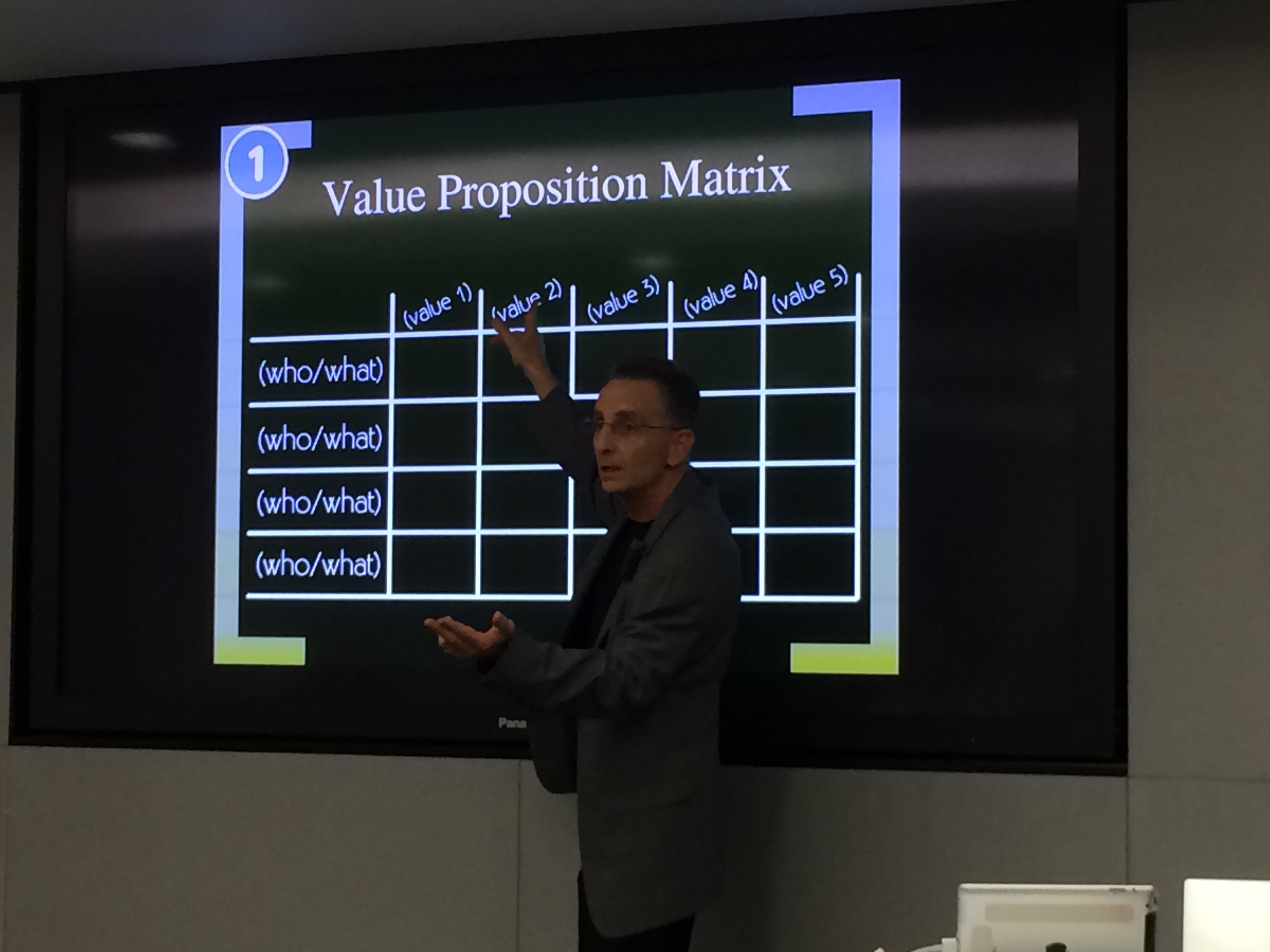
Value Proposition Matrix from Nathan Gold

Value Proposition Matrix from Nathan Gold

If you’d like to brainstorm this then you can use a VP matrix (see photo). I can’t tell you how useful & important this bit is.  Half the people I meet can’t explain their business to me in less than 5 minutes never mind in a single sentence.  Keep in mind that you have to get to a place where you’re going to be able to pitch your entire business in an initial investor meeting that may be no longer than 10 minutes.  Brief and simple is good.

Before I move on, a word on elevator pitches. Nathan recommends that you have three versions – a 30 second, 60 second and 90 second elevator pitch.  I’d never heard this before but it makes perfect sense and it’s very useful to have these rehearsed & in your kit bag, ready to trot out as required.

Still related to explaining what you do, use a Simile – “A is like B”.  Use this when you’re explaining in more & more detail & people still don’t get it.  Nathan’s own version of VP + S is “I help people prepare for high stakes presentations by rehearsing them as if they were in a Broadway show”.  See how effective that is.  Even if you’ve never been to a Broadway show you can immediately imagine how much work goes into the rehearsing.  When he said it, I imagined a couple of founders standing in a room in front of Nathan, going over & over & over their pitch until every word & image had been scrutinised, every aspect of it discussed in full and until their delivery of it was flawless!

Or if it’s easier, use an Analogy “A is to B as C is to D” – to illustrate this Nathan used the example of a company in San Francisco who’ve launched an electronic surfboard.  They explain it using this analogy “We do for surfing what the chair lift does for ski-ing” – see how easy that is to understand now as opposed to wondering what on earth someone would use an electric surfboard for…

A Metaphor works like “A is B” and the last bit of the first SAME is Examples – use them appropriately & drop in an S an A or a M to bring them to life.  Remember – investors see a hundred pitches a week, plus all the stuff they look at online & on video via the angel networks.  Out of the thousands of companies they see pitch, they invest in a handful.  The hardest bit when you’re starting out is getting noticed & being given an opportunity to pitch.  You will make it easier for yourself if you’ve really, really thought about your VP & how that sounds to the audience you’re presenting to.

Onto the second round of SAME.  When you’re presenting – whatever it is – start with a Story.  Don’t jump straight into factoids.  As your company grows, make sure you collect and share those stories so that everyone in the team knows them and can use them.  Nathan uses a Story Matrix to collate and classify the different types.  I like this.  We collected stories for every occasion as we were building Learning Pool.  They’re so useful.  Everyone loves a story and everyone warms to a storyteller – as long as you’re honest, authentic and real!  In the Story Matrix use the same layout as the VP Matrix.  Your column headings are Company, Sales, Support, Me, etc & your Row headings are story types – so Success, Failure, Fun, Legends, etc. Legends are the stories that are really hard to believe but which you can prove if challenged!

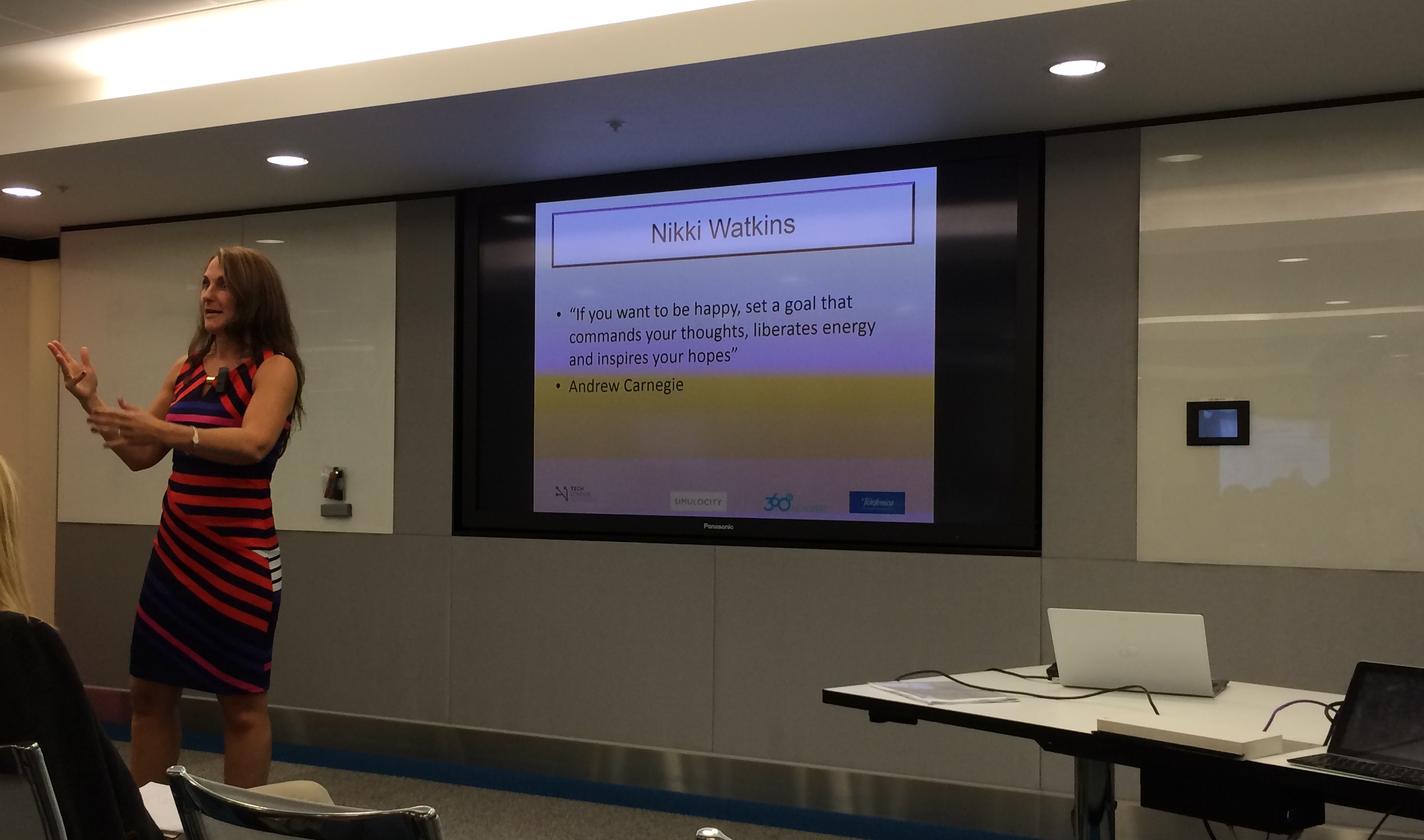
Nikki Watkins

Nikki Watkins

The next A is Adjective, and it’s the one you should add to your job title when people ask you what you do.  As well as coach, Nikki Watkins describes herself as adventurer, evangelist, believer.  I know they aren’t adjectives but this A is about being more descriptive about yourself upon introduction so that you will be remembered.  Nathan used a nice example “I am an entrepreneur with the soul of a dancer” – the entrepreneur in question has a dance related business.

Next we get onto one which is great when talking to customers but not so good for hard nosed investors…it’s a sprinkling of Magic.
The final E is Enthusiasm and your ability to communicate the passion you feel for your product, service, idea, company, life itself.  If you don’t have this then don’t present because this is the number one ingredient in your presentation.

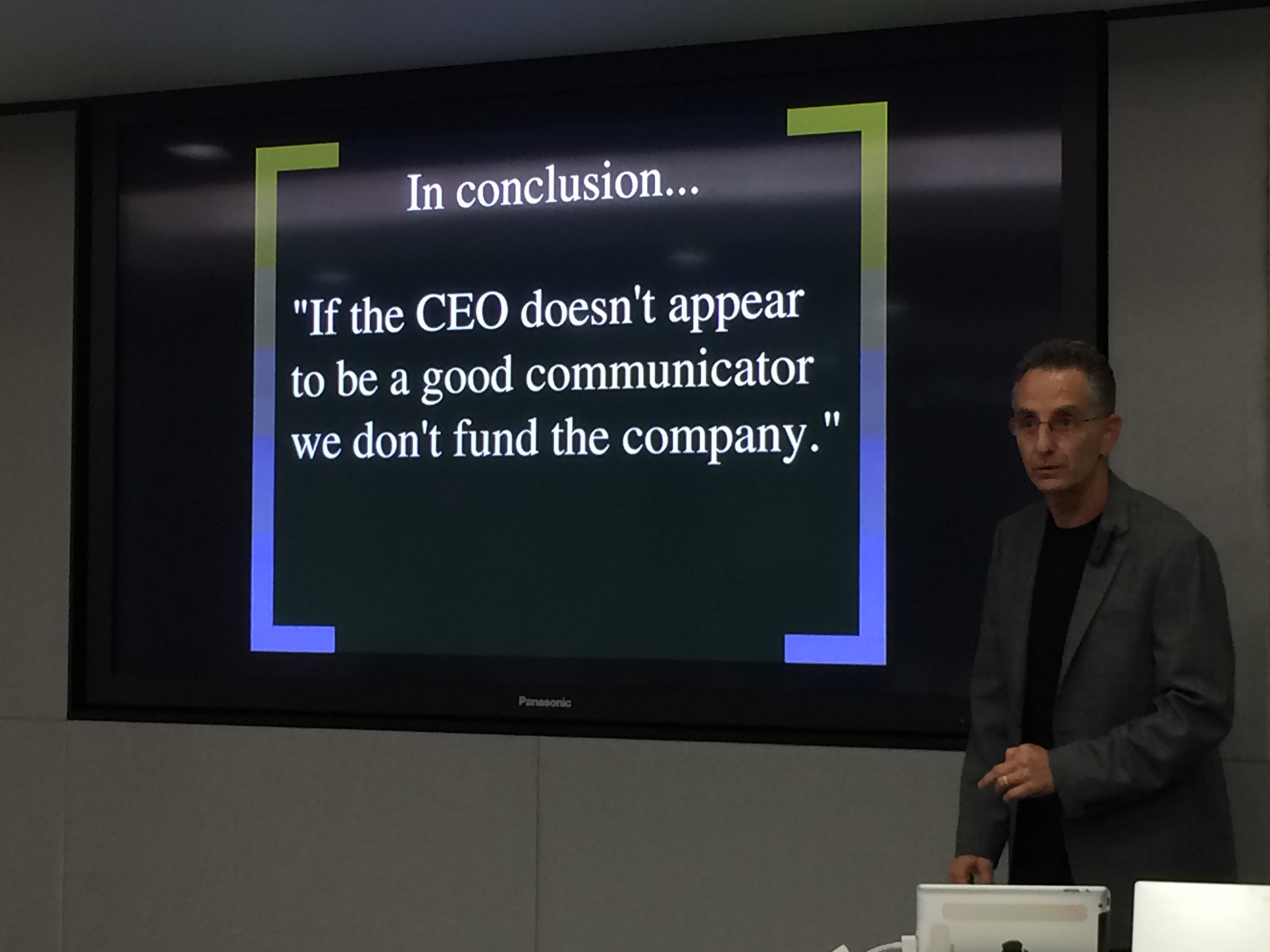
Anne Winblad as quoted by Nathan Gold

Nathan left us with a great quote from Anne Winblad of Hummer Winblad Venture Partners “If the CEO doesn’t appear to be a good communicator we don’t fund the company”.

I’ll leave you with a famous story. During a visit to the NASA space centre in 1962, President Kennedy noticed a janitor carrying a broom.  He interrupted his tour, walked over to the man and said, “Hi, I’m Jack Kennedy. What are you doing?”

“Well, Mr President” the janitor responded, “I’m helping put a man on the moon.”

Really think about your messaging, especially when you’re pitching.

Thank you for your insights Nathan and for sharing VP + (SAME)2 with me.  I hope everyone finds this as useful as I did.