My London Life – recommendations for places to go & things to do

I find myself telling people I moved to London “the other day” but in truth it’s been over a year now since I’ve been living in central London.  I miss Ireland, I miss the countryside at home in County Tyrone & I miss being in the Learning Pool mothership in Derry at the heart of our team but I’m also really loving my new London Life.  Living here this time around I’ve found London to be jumping with things to do & I’ve found it to be a far friendlier place to live than I remember from last time – but maybe it was me who changed in the intervening 12 years.

This is adrift from my usual business related blog topics but I thought it would be fun to jot down some of what I’ve enjoyed most about the last year in London.  Might be interesting for visitors & tourists.  I know everyone will have their own favourite recommendations so please feel free to add yours in the comments below.  I’ve gone for stuff which is free or low cost & which everyone can have access to.

  1. Hang out in any of London’s independent coffee shops and bakeries.  There are hundreds of them and they’re all magic.French-BakeryStay away from the chains.  As well as some of them dodging UK tax they are also as boring as sin, usually packed and they often serve coffee that tastes rotten and is way overpriced.  Locally to me I have the French Bakery in County Hall (south side of Westminster Bridge on the Southbank) & I have the Greensmiths Food Company on Lower Marsh St – the most divine & affordable cakes are baked on site by the chef for their cafe.
  2. If you want to impress someone with a great view & a bit of history then take them for tea in the Southbank Marriott hotel.  I know this is a direct contradiction of my recommendation No 1 but I can’t help being contrary.  It’s the old GLC building and was the seat of London government from the 1920s until 1986.GLCMany of it’s original features have been retained by the new owners including the beautiful wood panelling throughout the common areas.  Don’t miss the photographs taken at the time the building was going up and don’t miss the many period cartoons of Ken Livingstone & Margaret Thatcher.  The tea rooms look out directly over the Houses of Parliament, the River & Big Ben.  My friend Tom Phillips & I called in there recently although we didn’t even buy anything – we just had a look around – no-one seemed to mind.
  3. Eating Lebanese food on the Edgware Road and shopping in some of the local grocery stores.  Magnificent & easy on the wallet.  Completely authentic & cheaper than getting on a plane.  Sights and sounds from afar & waves of aniseed from the outdoor shisha smokers as you walk along the street.

  4. Ronnie-ScottRonnie Scott’s at Sunday lunchtime for intimacy, jazz and a taste of old world glamour.  It’s exactly as I imagine clubs in New York to have been in the 1950s in my mind’s eye.  Red velvet & table lamps, waiter service even if all you want is a glass of water, prime people watching…time travel without the machine.
  5. Last minute tickets to the theatre or the ballet.  We go to see everything that we have time for.  If the show is completely sold out you can queue for returns – you get lucky about 50% of the time in my experience.  You can see shows at the National Theatre on the Southbank for as little as £12 (or even £5 if you’re prepared to stand and aren’t yet too decrepit).  Some plays are better than others of course but they’re all enjoyable.  Going to see live performance is an incredible privilege and it’s just so easy in London.
  6. Joining the curator-led tours at the National Gallery.  These are brilliant, last an hour & they are free.  I’ve been on 4 or 5 so far & have seen different paintings every time.  Having the curator explain the paintings gives you a completely different perspective & insight.
  7. Leake Street Graffiti Tunnel – live art in the making & constantly changing – and I mean constantly changing.Queen-with-teapot  Maeve McLaughlin snapped this picture of the Queen last week and it was gone the very next day – her Majesty had been replaced with a rather rubbishy robot – which again has since been replaced by something else.  Utterly amazing.  Do not miss it.  It looks a bit menacing at first glance but it’s perfectly safe and there’s a 24 hour car wash going on in the middle of all the photography shoots and biker gatherings and film-making and all the other stuff that’s going on.  About 5 minutes walk from Waterloo station.
  8. Visit Parliament for free.  You don’t have to pay.  You just show up at the visitor’s entrance, queue & go through security and next thing you know you’re in Westminster Hall surrounded by history.  Dependent on how busy it is you might even get into the Gallery to observe Parliament in action if you’re lucky and well behaved.  The Parliamentary Outreach team is working hard to make Parliament more accessible to us all so watch their website for the free events that take place from time to time.
  9. Send off for free tickets to BBC recordings.Billy-BraggThe one we got tickets for was in Maida Vale Studio to be part of the audience for a Radio 4 Mastertapes show featuring Billy Bragg.  It was utterly brilliant and so was he.  Look on the BBC website where all their open events are advertised.  All you need to do is email them & you’ll find out a few days later whether or not you’ve been allocated tickets.  Be sure you show up in time on the night as they overbook & you might not get in if you’re last to arrive and everyone else has turned up.  Great fun and completely free.
  10. Sign up for some low cost learning related events.  The two I attended & enjoyed the most in 2012 were Tedx Houses of Parliament (happening again 14 June 2013, tickets go on sale tomorrow 4 March, great lineup again this year, I thoroughly recommend this) and the Mozfest (from the Mozilla Foundation) which will be happening again in late October 2013 in London.MozillaHang out with some like minded people & learn some stuff too – what’s not to like.
  11. Take the riverboat up or down the Thames using your Oyster card.  Viewing from the River gives you a different perspective on the City and you can see stuff you wouldn’t normally see.  If you manage to get as far as the O2, go over to the ExCel conference centre by cable car – also using your Oyster card.  Great fun and not anything like as terrifying as it looks from the ground.
  12. My last one is spending summer evenings in the parks.  The Serpentine Bar & Kitchen was a particular favourite of Team Learning Pool in summer 2012 – we spent the long summer evenings in their garden – eating pizza from the woodfired oven, drinking a few light ales, watching the ducks swim past & speculating about how much fun it would be to have a Learning Pool summer party in a flotilla of those pedal boats.

I’ll finish up with my favourite pic of the boys from last summer, snapped outside of the Queen Victoria in Connaught Village.  London summer evenings are pretty perfect and should be enjoyed outdoors.  London’s a great place to live and visit.  My advice for London Life is keep your eyes open for all the wonderful things there are to see, be friendly to the people you meet and when anyone invites you to stuff – say yes!
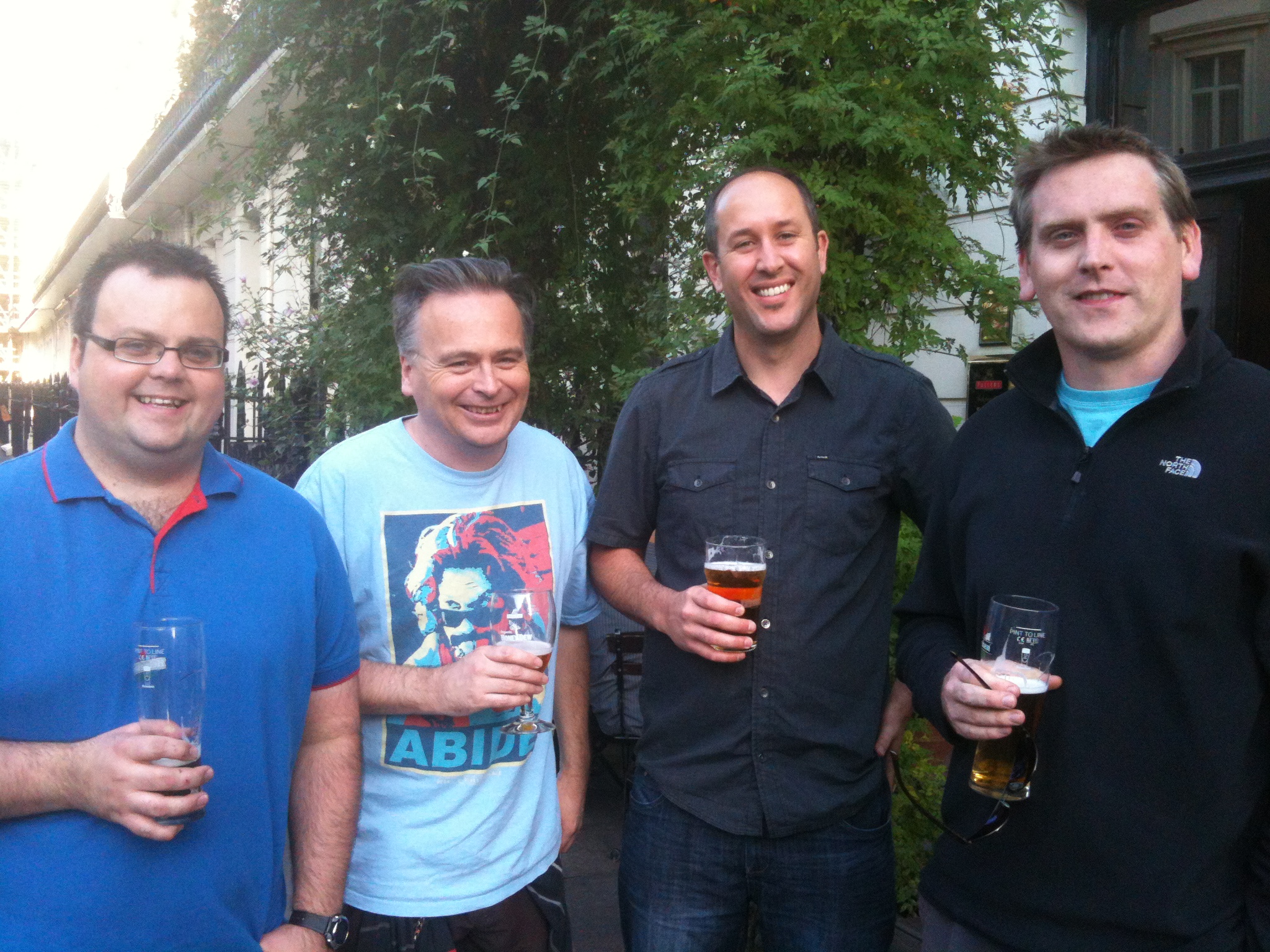
Boys-with-beers-Connaught

Women – would you like to earn as much money as your male colleagues?

I was at #altukgc13 yesterday on the 5th floor of the Royal Festival Hall.  It came about thanks to Lloyd Davis & James Cattell who jumped into action following cancellation of UK Govcamp because of a bit of snow & the chaos that wreaks on the British public transport network (I note that even Buzz Aldrin had to take the train from London to Edinburgh on Friday and sit in standard class, although from the photos online he appeared to be having a great time).

One of the groups I joined discussed why it is that conference speaking platform slots are overwhelmingly dominated by white, middle aged males.  We had a lively discussion & generated some ideas.  One of the women in the group, the very fabulous & sadly ex-public sector Sharon O’Dea, has successfully managed to break onto the speaking circuit herself where she talks about technology.  Rare indeed.  Sharon agreed that she will write a blog with some tips for interested people on how they may do the same.  You can find Sharon’s blog at http://sharonodea.co.uk/

The discussion got me thinking that many of the reasons that women in particular don’t put themselves forward for speaking slots are similar to the reasons why women are so rubbish at either negotiating or improving their salary packages.  That was my driver for writing this blog.  When I was a younger person in a junior job it didn’t occur to me that there was a difference in outcomes of salary negotiations between men & women.  I naively assumed that everyone did as well as each other.  I knew I felt a bit uncomfortable having to wrangle with my MD in this way once a year.  Then one day in a team meeting a wonderful woman that I used to work with, Kirsten Gillingham (now Bursar at St Antony’s College, Oxford) challenged our MD about this inequality & made reference to the many studies that have been done showing that women are extremely unwilling to negotiate their salary and are financially disadvantaged as a result.  For me, merely becoming aware of this fact was enough to bring about a change in my own behaviour from that moment on – another reason for writing the blog as hopefully the same thing will happen for at least one person that reads it.

When you get to the stats they’re a bit alarming.  For new graduates, 57% of men negotiate a higher starting salary than the sum they are first offered but only 7% of women do.  In recruitment exercises, 90% of men immediately ask for more money when their offer comes through but over 50% of women accept the first offer.  Women earn about 75% of what men do in the same role.  I’m not talking about the public sector here or organisations where there is a transparent pay scale – although I will say that even then, you do still have a chance of negotiating a better deal when you’re joining the organisation.

So why is this?  What are the contributing factors?  I think there are probably a lot including:

  • women systematically underestimate their own abilities and performance
  • women underestimate their own value and the contribution they make to an organisation
  • women often aren’t used to negotiation because of the types of jobs they do
  • women probably care more about fairness
  • women are nervous & less confident of their position if they don’t have complete information – in this context specific salary information on other people is unlikely to be available
  • women don’t usually like conflict & will be extremely reluctant to threaten to walk if they don’t get what they want
  • at recruitment time, women may believe they’ll be able to improve their lot once they’ve started working & demonstrated their value to the organisation
  • perhaps women are more scared of losing the job offer than men are
  • maybe bosses treat this as a bit of a game and women don’t readily understand the rules
  • perhaps worst of all, success & likeability are positively correlated for men & negatively correlated for women – I can think of many occasions where I’ve underplayed my own achievements in order to be better liked or more easily accepted (we publicly put our success down to luck or help from other people).  So the male that negotiates a great package for himself is seen as an all-round great guy whereas the woman who does the same thing is seen as a hardnosed ballbreaker.

No doubt there are many more.

So how can you improve your salary negotiation outcome?

  1. By being aware that this is just how things are done.  It isn’t personal and you may not like it.  During the hiring process most company’s recruiters will start by offering you less than they are authorised to spend on the post.  It is perfectly acceptable for you to refuse that sum & state what your expectation is via a counter offer.  The negotiator will then often lowball you with another offer that is less than they can pay you.  Again – just stick to your guns & continue to counter offer.  Stay calm & polite at all times.  Don’t give any reasons why you want more money unless they really press you to.  Often they won’t.
  2. Be familiar with your industry metrics so that you know what’s realistic – it probably isn’t realistic to ask for £50k when you’ve been offered £25k – but who knows – dependent on your sector & skills maybe it is.
  3. Practice your negotiations with a friend or mentor & reassure yourself that your demands are reasonable.
  4. Remember that negotiation at its core is culturally masculine.
  5. Don’t be afraid to initiate a conversation with your manager about a salary increase – my own team is made up of males & females but inevitably it’s the men who will chance their arm and pitch to me the reasons why they deserve a pay rise, even when they aren’t due for one.

Ideally the process should be changed as there’s also a commercial downside & cost to behaving in this way.  No enlightened company will consciously operate like this as they will appreciate that in order to succeed commercially; they need a gender balanced and happy workforce who are treated fairly.  At Learning Pool we want our people to have the same opportunities and to be treated equitably.  We recognise the very large sums of money we spend recruiting and training our team members so it’s in our interests that they are content & stay with us for the long term.  There’s probably a special place in hell for managers who offer pay rises only at the point where their people threaten to leave.

When I was researching this topic last night I watched again Facebook’s Sheryl Sandberg’s famous TED talk entitled “Why We Have Too Few Women Leaders” – it’s just shy of 15 minutes long & well worth a viewing or another viewing.  I won’t repeat what she says but she makes some great points that really made me think.  The link is here http://www.ted.com/talks/sheryl_sandberg_why_we_have_too_few_women_leaders.html

I sincerely hope no-one is offended by this blog post.  That isn’t my intention & those of you who know me will know that I thrive in a male dominated sector and industry.  There’s lots more that can be said on this topic and I hope many of you will start a conversation using the comment section below.


Digital Future Gazing – 10 predictions for 2013

Breakfast with bright young things in the Soho Hotel

Yesterday I attended the 4th annual Digital Trends forecast presentation from digital PR agencies 33 Digital & Hotwire in the achingly trendy Soho Hotel.  It’s a world I don’t often stray into – marketeers, PR people, social media agencies, brands, influencing – inhabited by bright young things and beautiful people.  So what was I doing there?  I went because Peter Sigrist, MD at 33 Digital is part of my Twittergang & I wanted to see him present and also because who isn’t interested in future gazing & horizon scanning – especially when someone else is putting up the skittles & inviting everyone else to knock them down.

As it turns out, the bright young things were also well informed, fun and sincere & the event was very enjoyable.  I considered what impact the 10 predictions may have on my own public sector world – and my musings on this are below.  You can access the report in it’s entirety here www.digitaltrendsreport.com – it also contains some very cool b & w photographs.

Peter wants to encourage lively debate about the forecasts so feel free to join in on Twitter.  Use #hw33trends

  1. Internal Social Networks – yep – I like this one.  We’ve been using Yammer for years at Learning Pool & we know many of our public sector customers are trying to get started with something similar.  Our experience has been that it helps our dispersed team keep track of each other & it savagely reduces internal email.  In bigger organisations it allows everyone to communicate with each other on a more level playing field and it lets senior teams understand their own organisations better.  The challenge next will be to see if internal social networks will foster new ways to achieve business objectives and even sales.  We’ll see.  For anyone starting out with an internal social network, make it easy for your team to use & be patient.  There’s bound to be a few mistakes along the way but everyone learns and your organisation becomes more resilient as a result.
  2. Data Porn – the age of the data geek is finally here, Big Data has arrived.  The PR agencies are excited about the release of the 2011 Census data in early 2013.  This time around the data will be there in a format where everyone can access it & slice & dice until the cows come home.  What does this mean for the UK public sector?  A recent Policy Exchange report estimates that fully capturing the big data opportunity to drive up efficiency and cut out waste in the UK public sector could be worth a total of between £16 billion and £33 billion
    a year.  What’s keeping you folks?  For anyone out there who’d like to know more about what Big Data is, there’s a new e-learning course in the Learning Pool catalogue that we developed with the Cabinet Office & explains Big Data for public sector beginners.
  3. Digital Health – in 2011 global healthcare costs totalled £3.8 trillion according to McKinsey & in the US costs were 20% of GDP.  This prediction is about government encouraging people to measure & monitor their own health data to ultimately help them to help themselves to become more healthy.  I think whether we like it or not this is definitely on the cards.  I heard Nick Seddon of think tank Reform talk about this idea at length at July’s CIPFA conference and given that he was previously at Circle Healthcare he probably has a good idea about the way things are moving.  On a more positive note, people these days want to take charge of their own health.  We’ve seen that in our own team during 2012 with a number of people finally kicking the cigarette habit & the proliferation of bicycle purchases.

    Peter Sigrist, MD of 33 Digital, revealing the first 5 predictions

  4. When businesses learned to be good – I like this one too & definitely agree that this is on an upward & escalating trajectory.  This topic even formed part of the CBI’s recent annual conference which included an entire panel session titled “Growing with Society – the need for new Business Models” led by Unilever’s CEO Paul Polman.  Modern businesses are becoming more transparent, more connected (and in a way where serendipity starts to play more of a role) and more community focused – both internally & externally.  For the public sector, I predict that the coming years will see a complete blurring between government, the private sector and the not for profit space as a new type of organisation emerges to deliver services to citizens.
  5. Smaller can be better – the rise of the niche social network and a move away from Facebook & Twitter.  This one is all about creating communities of interest where the measure is not the size of the community but the degree of engagement.  It’s what we’ve been doing for a few years at Learning Pool with our own specialist Learning & Development community and this is a fairly well developed idea within the public sector with many niche Communities of Practice available in recognised places like the LGA’s Knowledge Hub.  Peter talked about examples of “sub compact publishing” such as Bobbie Johnson’s “Matter” project – very interesting and described as – basically the opposite of all the received wisdom about online publishing — they only publish long pieces, they don’t publish very often, and they expect people to pay for content.
  6. Sentient World – this is where it starts to get a bit scary.  Social media gave interested parties the ability to listen to what we say; the sentient world will give them the ability to see what we’re doing.  Foursquare has launched a service for business this past week and one of their original co-founders is apparently working on a version of tweetdeck for Foursquare.  One for the public sector to sit back & think about I believe as we watch the early adopters.  Sometimes called the Internet of Things, to the layman it’s sensors & transmitters within inanimate objects connected via the internet – fridges that order more milk, shoes that can tell you how to get home, a lamp that when you switch it on in London lights your sister’s lamp in Co Tyrone so that she knows you’re at home, mirrors in shops that tell you more about the coat you’re trying on, thermostats that learn which rooms you don’t go into so they leave them colder.  I loved the story about the Fitbit & the leaderboard & this is something we will definitely be trying out in Learning Pool as the New Year kicks off.  Who can walk 1,000 miles first?  My bet is on Eddie Ryce.
  7. The Rise of Storytelling – every FTSE100 company now has a community management team.  Two years ago none of them did.  This is about using compelling stories with a beginning, a middle and an end to bring audiences to you, get them to stick around & ultimately to buy more stuff from you.  I see lots of examples of public sector organisations pushing out stories about the places they are in & the people they serve.
  8. The Un-Boxing of TV – yep – agree with this.  I can’t watch tv any more without Twitter banter running in parallel & everyone I know is the same.  Can’t think of a public sector application of this one as all that is televised is council meetings & I don’t think anyone watches them anyway.  Maybe use this medium & idea to push out campaigns about public health or to encourage more engagement in local democracy?  I have a horrific metric for you however – 70% of trending topics on Twitter are TV related 😦
  9. Selling’s from Mars, engaging’s from Venus – remember that you can only manage what you measure.  It’s easy to measure sales.  Engagement isn’t as easy to measure.  We had a good laugh about Twitter campaigns that have backfired & one that we discussed was the Waitrose campaign that asked people why they shop at Waitrose – cue hilarious results (Harrods is too far to go midweek, because I was once in the Holloway Rd branch & heard a dad say “put down that papaya Orlando”, Asda doesn’t stock peacock/unicorn feed, if you buy a full tank of helicopter fuel you get 10% off champagne and so on).  Rather than backfiring I think that campaign was a resounding success.  I think the public sector understands that if you want citizens to engage, you have to hold conversations on topics they are interested in but perhaps we don’t see enough of this happening.
  10. The User Experience of Social – this one is about thinking through the entire user experience that people have when they interact with us in more than one place.  In my opinion no-one does this right.  I’ve recently been accessing estate agent websites on my smartphone when I’m out & about & they are a curse – every last one of them.  This is about waking up to the fact that channels do not contain siloed audiences – the same people are using multi channels.  Everyone including the public sector needs to think a lot harder about UX from multiple devices & including more”helping hand services” that align service offerings & save time & energy for the user.

I hope you’ve enjoyed reading this blog as much as I enjoyed yesterday’s event, even if I can’t extend the Soho Hotel breakfast to you.  I saw Jon Foster of Futuregov yesterday & we were debating whether or not local authorities really should start thinking more like brands.  We concluded that they probably should.  It’s certainly time for everyone to take better control of their conversations and interactions in a more holistic way.

As always, I look forward to your comments & your own predictions for Digital for 2013.

How to motivate your team…Lorraine Heggessey style

Last week Paul Webster (@watfordgap to the twitterati amongst you) & I were lucky enough to take a day out to represent Learning Pool at the Skills Third Sector conference.  The headline theme of the day was Our People, Our Skills, Our Future and we were keen to share with others what we’ve been working on for the past few years in other parts of the public sector.

Dame Mary Marsh addressing the Skills Third Sector Conference

Dame Mary Marsh of the Clore Social Leadership Programme was one of the keynote speakers.  Those of you who are familiar with the voluntary sector will be aware that Dame Mary has recently been appointed by the Cabinet Office to lead a review of leadership and skills which is due to be delivered in Spring 2013.  I was very encouraged that she spoke about now being a time for the sector to be bold and have the courage to do things differently and in a more entrepreneurial way.  Indeed, in a nutshell the key strands of the day that everyone kept returning to were:

  • the sector needs to invest in upskilling its people
  • better use can be made of technology to do things differently and in a more cost effective way
  • an opportunity exists to share more stuff both across the voluntary sector and between different sectors.


Nick Hurd, Minister for Civil Society

We listened to Nick Hurd (a man who has so far been a banker and an MP and who fears he may end up as a journalist or an estate agent) tell us about how he believes the sector must bring in more people with business skills as trustees.  He also made the very sensible observation that everything is always about the people and that leadership is especially important in times of significant change.  I was especially pleased to hear him suggest that the sector should take time to seek what is already out there and make use of it.  I have a dread of organisations or indeed entire sectors reinventing the wheel over & over again, simply because they haven’t taken the time to have a good look at what already exists – let’s face it – we’ve all seen that happen time & time again.

Later in the day Lord Victor Adebowale warned us that 88% of public sector cuts are still to come and he talked about the importance of collaboration and sharing learning across sectors.  Music to our ears.

Lorraine Heggessey, impressive career woman & role model


The speaker I really enjoyed, however, was Lorraine Heggessey, former BBC1 controller and the first woman to ever hold this post (despite the obvious handicaps of not being male, tall or having an Oxbridge background).  Lorraine talked to us about how managers & leaders can motivate their teams and make people feel valued in what they are doing.  These were a few of her suggestions and observations:

  • Think of your people as “talent” in the way that tv does and remember that talent is needy – Lorraine should know as Simon Cowell and Lord Sugar are just a couple of the people she’s had to work with
  • Remember that telepathy doesn’t work as a management tool, you have to rely on communication (Lorraine told us a story about how a colleague used to constantly arrive late for work & then spend 30 minutes chatting to her friend on the phone; her manager tried to deal with the situation by glaring at her & rolling her eyes, hoping she would take the hint.  Eventually the manager lost her temper and there was a big row.  The person simply said “you should’ve said” and from that moment onwards behaved at work in the way expected of her)
  • As a manager your behaviour is observed and noted – people in your team watch who you pay attention to & who you don’t pay attention to – it is noticed so be aware of that.
  • Greg Dyke ran a “cut the crap” programme at the BBC and asked staff what they wanted to change.  They said they wanted to stop tolerating maverick & diva behaviour from people in the team who won awards and critical acclaim.  They became known as the Bafta Bastards.  Greg tackled the issue & some of those people left the BBC.  So – think about who you are rewarding.  Every organisation has its stars but if you don’t manage & reward them carefully, you too could end up with a team of BBs
  • Watch out for people in the team falling out of someone’s favour & becoming “not very good” – it might be because they’ve been badly managed & demoralised.  Lorraine told us about how the BBC had a culture of not confronting poor performance but how managers would instead pass the person on to someone else.  All of us have seen that happen.  Better to address the root cause of any issue.
  • Manage by walking about – if you don’t spend time with your team you can’t manage them
  • Employ the best, not the easiest
  • Always employ people smarter than you when you get a chance
  • Spot when your people need to be challenged – if you don’t provide your team members with challenge they will get bored and leave.

Lorraine left us with a quote that I love “Everybody has a lot to learn from everybody”.  She also told us that she became a much better manager once she was a mother.

Fortunately, most of us are lucky enough not to work in environments like the BBC but still some good learns from Lorraine’s talk that are appropriate to most workplaces and teams.

Lorraine & Lord Victor finished by challenging the conference to start a movement to rename “the Third Sector” and to call it something else.  I’d be interested in hearing any suggestions you have in the comments below.  I know this has been a recurring theme for some years but maybe now is the right time to change to something more positive.

Changing careers might not be as hard as you think

These days it’s more usual than it used to be to meet people who are onto their third or fourth career.  I can think of quite a few examples amongst my own group of friends and associates.  On Friday at the London IIBN conference I met Niall Quinn & then heard him talk about his own transition from footballer (Arsenal, Manchester City, Sunderland and of course the Republic of Ireland) to Sky Sports commentator to entrepreneur/businessman (when he led the buyout of Sunderland AFC by the Drumville consortium) and now executive Chairman of newco Q Sat, a rural broadband provider.

Any of you who know me will not be surprised to see there’s a photo involved – many thanks to Sinead Crowley of IIBN for snapping that one below!

Mary McKenna with Niall Quinn at the IIBN conference in London on 9 Nov 2012

Niall shared his brutally honest insights with us in his talk & I thought I would in turn share some of them with you.  He talked first about how he now views his former life as a footballer as quite a false existence.  He used to go training in the mornings & then come home & lie on the sofa.  His wife would bring him his meals & make sure the children left him alone.  When his first career came to an end he was quite depressed about it & drifted into a job at Sky Sports which although it paid the bills, didn’t really put fire in his belly.

Then he saw his old club Sunderland AFC in trouble, met with his former chairman & after talking to a few of his Irish contacts decided to lead the buyout & after a short (unsuccessful) spell as manager Niall moved into the Chairman’s seat.  Along the way he had to stop being a footballer and learn to be a business person.

He found he enjoyed the change and the new challenges and he began to take an interest in new technology.  This interest has culminated in Niall moving into a start up business as their executive Chairman.  He commented what a big difference it is between selling footballers for £50m & persuading someone to pay you £35 per month for broadband.  Q Sat has grown from 22 to 50 employees in the time he’s been there and they now have 11,000 customers (6,000 of those in rural Ireland) and are about to open an office in Nairobi.  It’s clear to see that Niall enjoys building relationships with partners and putting something back as well as building a successful and profitable business.  He talked a lot about the mentors he has learned from (in football and in business) and the way his company is seeking to build on the work that other Irish people have done before, especially in Africa.  One of the pieces of advice he offered to us was in business to keep some space aside to meet people, have conversations and network.  I’m a great believer in this approach too.

One of the funny stories he told us was about one of his friends Patrick M’Boma, a Cameroon striker and former teammate at Sunderland.  The two guys had clashed heads & both gone down.  Niall claims he knew his time playing at Sunderland was over when the physio ran onto the pitch & ran straight past him & over to Patrick.  For me thinking about this since, it seems that the life of a footballer is indeed different – as you’re either on the way up or you’re on the way down – the time at the top seems fleeting & hard to define.  Hopefully Niall doesn’t miss that aspect of his first career although I’m guessing the same boy has hung onto his competitive streak which will do him no harm.  I’m also guessing he’s enjoying being part of a team again as that team spirit is one of the most fun things about being in a small, growing company.  He said that one of the odd things about being a footballer is that although you play in a team, you still hope you are the best in the team – something that doesn’t really come up in a business because everyone has their own defined role to play as part of the overall team success.

He finished by saying that looking back he wonders now how much further ahead he would be in business if he’d quit football 10 years earlier.  We have a rule Niall – no regrets.  It’s the experiences you have along the way that makes you the person you are – and if you meddle with the order then who knows where we’d all end up.  Good luck with career number 4.

So – some people change career because they have to & some because they want to.  Whatever your reason get on, grasp the nettle and don’t be afraid to ask your network for help and advice.  Great speaker, great conference and thank you to all at IIBN for making it a lot easier for the Irish diaspora to do business outside of Ireland.  Please share your career change stories in the comments below – you know I love to read them.


5 top tips to keep that small company culture as your startup grows?

Not so long ago Learning Pool was 4 people congregating around Paul’s kitchen table in Donegal.  6 years later we employ 50 people, support over 700,000 learners & 350 public sector organisations & Deloitte’s have deemed us to be the 26th fastest growing technology business in the UK over the past 5 years (6th fastest growing on the island of Ireland) with 1100% growth in our revenues in that period.  At the same time, our customers tell us that our business feels more like a family to them than a company.  This week’s blog is about how I think we’ve managed to combine aggressive growth with retention of the desirable qualities of a small business and keeping hold of our personal values along the way.  I appreciate this is a topic that many of you will know far more about than me so I’m looking forward to reading & answering your comments and questions.

Learning Pool team having cake – which happens pretty much weekly

Before I start I should say that one of the greatest pleasures of owning your own business is having the opportunity to shape the culture of your organisation because we all know too well what bad company culture looks and feels like.

These are my top tips:

Aine and Emma – two of our original Learning Pool team members snapped last week at LP Learning Live South

  1. Invest in your own people and help them grow with the business.  Today our team extends to more than 50 people, but 15 of those 50 have been with Learning Pool more than or very close to 5 of our 6 years and not one of them is in the job they started at – they’ve all moved up or sideways and up.  Many of our team did not have years of experience when they joined Learning Pool, but what they lacked in experience they made up for with great personalities, enthusiasm and energy, a hunger to learn and desire for success.  Our original company culture is carried in each of their hearts and delivered via their daily actions.
  2. Linked to point 1 above is take care with your recruitment.  Recruitment is the most important job of a fast growing company’s founders so make proper time for it & don’t delegate it to someone else.  The worst mistakes we’ve made in our 6 years so far have all been linked to poor recruitment decisions.  You know what they say – better a hole than an asshole – and it’s true.  Avoid prima donnas and mavericks, whatever they seem to bring – they just aren’t worth it.  Recruit for potential and personality and work hard to develop your talent.  When you make a recruitment mistake, reverse the person out as quickly & as painlessly as you can for their own sake and for everyone else’s.

    At the end of last week’s LP Learning Live South

  3. It’s easy to be customer focused when you’re small.  As a startup you have to over deliver anyway and when you’re starting out you don’t have many customers and you’re eagerly learning from them.  As you grow, you have to find a way of continuing to deliver that level of excellent customer service.  We’ve done this by constantly automating as much as we can as we’ve grown so that our customer facing people get to spend as much of their working week as they can interacting with customers – as that’s where the value add lies for our customers and for us.  We’re about to go through another (painful) round of this between now & Christmas but we recognise it’s worth it.
  4. Encourage everyone to have their say.  We’ve tried hard to do this at Learning Pool from the very start.  We have a culture where everyone’s ideas are heard and debated (even Tony’s) and everyone is expected to innovate.  We’ve used Yammer for years to facilitate ad hoc brainstorming across our dispersed team and it’s also used for extensive banter and leg pulling.  I used to worry about this but it’s only made me nearly faint once & that was when a local authority HR director asked me if they could see Yammer working in situ.

    Night out in Dublin 2011

  5. As founders and senior managers you have to love your team and all of you have to love your customers and enjoy interacting with them.  None of that can be faked.  It has to be real.  What do I mean by love your team?  You have to care about them in & out of work and sometimes even take care of them, you have to appreciate the contribution they make and reward them as best you can – financially and in other ways, you have to trust them and give them space to develop and progress.  You have to make time to have some fun together as that’s important too.  The Learning Pool team works hard but we play hard too and we find time to do some voluntary & pro bono work together when we can.

Team in pink for Breast Cancer Awareness Day

That’s my thoughts.  Look forward to reading yours.

What makes us different?

Edge of CliffThe amazing photo on this week’s blog is of Norwegian extreme artist Eskil Ronningsbakken.  Why am I using it?  Because I heard a saying about startup entrepreneurs a couple of weeks back that I liked.  It was “if you’re not at the edge, you’re taking up too much room”.  Other sayings  I like on this topic are “If the wheels don’t come off, you’re not travelling fast enough” and also “If you can’t code and you can’t sell, get the f*** out of my way”.

I think a lot about why it is some people can cope with running small businesses and others can’t.  In my view it comes down to 3 things.

The first is a stronger ability than most people to be able to compartmentalise stuff.  What I mean by this is that you can carry on doing what you need to do at that point in time (be it get up on the podium and pitch to investors, focus on getting a tender response finished or complete a sales call) when something else distracting is going on – either in your business or in your personal life.  Being able to compartmentalise in this way also allows you to block out other bad stuff that you would otherwise worry about.  When bad things happen, as they do from time to time, I think about them and if there’s nothing I can do right this minute or today to address them, then I put them out of my mind until the time is right to deal with them.  I don’t lie awake at night worrying.  I put them out of my mind in a locked box that I open when the time is right.  If I couldn’t do that, I’d never get anything done.  I’d be paralysed with fear.

The second is resilience.  I’ve seen a couple of entrepreneur buddies in the last couple of weeks who have really been under the cosh recently.  If they weren’t so resilient they’d have given up, one in particular many times over.  What is resilience?  The official definition of resilience is an ability to bounce back into shape.  In a work setting it means being able to continue functioning & making sensible decisions in the face of adversity – which could be a one off event (like a disaster) or longer term (like always being tired from working long hours consistently).  Resilience is what you need when the 10th bank you’ve spoken to that week won’t lend you money & you don’t have enough to cover payroll right now, it’s the quality that makes you get up at 3am to go & catch a plane even though you only got home at 10pm last night, it’s what makes you sit down & start working on another response to tender when you’ve just had a rejection letter in from something you thought was a dead cert.  In summary, this is the quality that keeps you going & you either have it or you don’t – so be honest with yourself.

Last on my list is the big one.  I used to think the big one was resilience but I’ve changed my mind.  It’s also the one out of the 3 that I think you can learn or at least improve.  It’s the ability or willingness to make quick decisions.  I make a lot of decisions in my job. Some days it’s all I do.  But there’s more.  It’s the ability to make decisions when you have no or certainly less than perfect information and it’s the ability to make a decision and move on.  If everyone worked in an environment where they were encouraged or allowed to do this, the world would be a much better place.

I’m sure everyone has their own views about what should be in this top 3.  I look forward to your comments or questions as always.

10 quick questions to find out if you have what it takes to be a startup founder?

Today’s blog takes the form of a quiz to help you determine if you have the right qualities to be a startup founder or small business owner.  Not everyone does and this is a topic I’ve written about often in the past.  You all know the drill – it’s like one of those magazine quizzes everyone’s so fond of filling out in secret.  All I ask is that you’re at least honest with yourself…

1) You’ve been thinking about developing a new product and have done a couple of months market making.  You’re in a taxi between meetings in London when you receive a phone call from one of your spies who tells you a competitor is thinking along the same lines as you.  Do you:

a)      Phone the competitor and tell them to back off – it was your idea first

b)      Ring your bank, pitch your idea to your bank manager & see if he or she will lend you the money you need

c)       Scratch that idea and move onto the next one on your list – you have loads of ideas anyway

2) You badly need a Sales Exec to help your startup business cover more ground.  You engage a recruiter to help you find someone.  The next day you get a call from the recruiter – he’s decided he wants the job himself and he pitches to you on the phone.  You like the recruiter but he knows nothing about your sector.  Do you:

a)      Carry on with your original plan and interview according to the schedule – you’re sure to find someone with the right background and experience

b)      Decide to give the recruiter a chance – at least you know he will pitch and what’s the worst that can happen

c)       Look for a different recruitment firm that employs more professional recruiters

3) You’re at the airport when you run into a friend.  You’re chatting away when the person he’s at the airport to meet arrives.  Turns out he’s a visiting US venture capitalist.  You’re tentatively looking for investment.  Your friend introduces you and with no warning invites you to pitch to the American investor.  Do you:

a)      Give him your business card and say you’ll send him some information about your company and give him a call the next day

b)      Trot out your elevator pitch as confidently as you can whilst shaking a bit inside

c)       Make your excuses and get the hell out of there as fast as you can

4) It’s Christmas Eve and your business partner rings you to say he’s just had a call from the bank and they’ve turned you down for the loan you thought was a dead cert.  It’s the 4th bank you’ve talked to during December and they’ve all refused to lend you any money.  Do you:

a)      Do nothing – you’re sure it will all work out ok come the New Year

b)      Carry on with your shopping, take Christmas day off (it’s Christmas after all) but on Boxing Day, get on the phone with your business partner and start writing a new business plan for the next bank you’ll be calling

c)       Cancel Christmas and make your entire family miserable

5) You get evicted from your London “office” – ok it was an apartment and you’ve breached the terms of your lease by running a business out of it.  You have a small team and they need desks.  Do you:

a)      Call an estate agent and start looking for an office – they cost a fortune but hey – it’s one of the overheads of running a business right?

b)      Ring a friend whose office you were in the other day.  You noticed he had 3 desks but was only using one of them

c)       Have a little cry

6) You’re developing a product for market and badly need to generate some revenue to bolster up your pitiful cashflow.  The product’s only about 20% complete.  Do you:

a)      Phone around and see if anyone else you know wants to pitch in and share the risk/reward

b)      Call a few prospects and cut them a special deal for being an early adopter of your new product

c)       Stop development whilst you scrabble about to raise the cash to continue

7) You come out of a long day of meetings in London where your phone has been on silent.  You have 26 missed calls.  There’s been a serious security alert and all the London airports are closed.  You have an important meeting in Northern Ireland at 10am the next morning which you cannot miss.  Do you:

a)      Go and find a hotel before they’re all booked up.  You’ll get a plane ok in the morning with a bit of luck

b)      Run like billy-o to Euston and jump on the first train to Scotland.  You know you’ll get an overnight ferry and be able to persuade someone to pick you up at the port in the morning

c)       Call and cancel the meeting.  It’s perfectly reasonable to reschedule in the circumstances

8) You receive an abusive letter from a supplier who’s threatening you with legal action for non payment of an invoice.  You haven’t paid it because the work they did for you was woeful and you’ve explained that to them.  Do you:

a)      Ignore the letter and hope they’ll go away

b)      Call them and make a reasonable offer for the work they’ve done; if they won’t see reason put it out of your mind on the basis that most people who threaten you with legal action never actually follow through

c)       Panic and call your lawyer straight away

9) You go and pitch to a VC and they send you a term sheet which you believe doesn’t represent the true worth of your company.  Do you:

a)      Go back to them and do your best to negotiate a better deal

b)      Go back and pitch again, receive an improved term sheet and then turn that one down – you know your company is worth more and those guys are likely to put it down the toilet anyway

c)       Take it anyway.  You’re desperate for the cash and you’re unlikely to get a better offer

10) You’re 2 years into your startup and at last you can take a bit of money out and get away for a brief holiday.  On the day you pay yourself your Mum’s dog gets run over by the postman and needs an operation which just happens to cost the same as your holiday money.  Do you:

a)      Have the dog put down, tell your Mum there was nothing could be done for it and buy her a new (similar) dog for a fraction of the price of the operation

b)      Pay for the bloody dog – there has to be some karma in this world

c)       Jump on the plane as fast as you can leaving your Mum to sort out her dog

Ok – so by now you’ve guessed that these are all real life situations that happened in my startup in our first couple of years.  For every one of the 10 scenarios above, we or I did (b).  Be interested if you agree whether or not we made the right choices.  I hope you had fun reading this.  It gave me a good laugh writing it and brought back a lot of happy memories from our early days.

Interactive art doesn’t have to be 21st Century

Yesterday I joined one of the National Gallery’s tours.  The excellent Steven Barrett, one of the National Gallery’s lecturers, took us on a whistlestop tour of the gallery & showed us 5 significant paintings.  The one I’m going to focus on for the purpose of this blog is Holbein’s “The Ambassadors” painted in 1533 and depicting two French dignataries visiting the court of King Henry VIII.  My reason for choosing it is that the painting is one of the earliest examples of interactivity in art and because of that I find it incredibly interesting.

Hans Holbein’s The Ambassadors, National Gallery London

Placed in the bottom centre of the painting is a strangely distorted surreal looking object which is an anamorphic skull.  The artist has used perspective to carefully distort it so that you can only see it as a skull when you view it from the right hand side of the painting with your eyes about 1.5m from the floor – from that perspective the skull pops into view & the rest of the picture disappears.

We think Jean de Dinteville (he on the left in the furs) hung the painting on his staircase back in France and the skull would jump out to people descending the staircase when they reached that crucial point and give them a shock – reminding them of their own mortality.

So – this is an early example of interactivity in art.  The way the artist has created this piece requires the viewer to do something & shift position to a different stance in order to fully experience the painting, to see worldliness disappear & the memento mori spring out.

Interesting eh?  I like also the contrast between the forensic detail of the rest of the painting and the distortion of the skull at the bottom.  Don’t miss the strangely angled crucifix in the top left corner.

Loads more written about this painting online including a couple of the National Gallery’s videos on youtube that explain the geekiness behind how the artist did the distortion accurately with the instruments he had available to him at the time.  The National Gallery is free to visit and a wonderful national resource.  I’m sure many of you pass it all the time, rushing to & from other places.  You really should take 15 minutes out & go and look at something beautiful or thought provoking.

For those that are interested, the other 4 paintings we saw were:

Paolo Uccello “Battle of San Romano” – an early attempt to create an illusion of 3D space

Carlo Crivelli “The Annunciation with Saint Emidius” – another early example of improved perspective in Medieval art

Joseph Wright “An Experiment on a Bird in an Air Pump”

Vincent’s “Sunflowers” – beautiful now but so controversial when it was painted.

I enjoyed the complete immersion in the hour long tour and listened to every word that Steven said.  It was possible to do this despite the crowds on a busy Saturday.  Thoroughly recommend it.

Pure Irish Gold…London 2012 Paralympics Celebration

Last night I was lucky enough to be at the newly opened & absolutely elegant St Pancras Hotel to celebrate the achievements of our 49 Irish Paralympians.  Here’s the entire team – looking good.

Paralympics Ireland Team 2012

For a tiny little (bankrupt) country on the periphery of Europe our athletes seem to have done overwhelmingly well in the London 2012 Games (8 gold medals, 3 silver & 5 bronze) over the past couple of weeks.

I apologise right here & right now for being biased towards my own tiny corner of the island of Ireland but 5 of those 8 golds are from 3 Northern Irish athletes including our local Eglinton man Jason Smyth.  Here I am snapped with Jason and his two (very heavy) gold medals at last night’s party.

Jason Smyth with me


I think he couldn’t believe it when I mentioned to him about us being based in Clarendon Street in Derry.  I also told Jason about being in the Olympic Park last Saturday, watching him pick up his gold on the big screen as the Irish anthem blasted out in the evening sun & about how proud I was.  I didn’t tell him about hiding my eyes from the friends I was with so that they wouldn’t see my tears.


Great to see everyone plus their families and friends enjoying themselves last night; having a few drinks & dancing the night away.  It was also interesting to hear from Paralympics Ireland CEO Liam Harbinson about how sponsorship for the team had increased from a single sponsor in Beijing four years ago to 18 sponsors for London 2012.

The Irish dancers take the stage


Chatting to a few people over the course of the evening the Irish team are already thinking about Rio in four years time and as so many of them are very young indeed, we should be well placed to pick up more than our fair share of medals.

My sister Trish chatted to one of the coaches as we were leaving the party.  He had been coaching 10 athletes for London 2012 & all of his team had attained new personal best times in London.  He told Trish that was his equivalent of a gold – 100% success with his team.

Jason Smyth and Patricia McVeigh


Here’s Trish with Jason too.


Cherry on the top news at the party was that Michael McKillop (also from Northern Ireland) is to be the recipient of the prestigious Whang Youn Dai Achievement Award as the male athlete who best exemplified the spirit of the Paralympics at the Games in London.  McKillop was selected because of the work he does with schoolchildren in Ireland.  Two great guys, room mates & friends as well.  Lovely to see them both last night being so gracious and generous to all the people who wanted photographs with them & to have a bit of chat & craic & to examine their gold medals etc.

Gathering watches celebrity accordionist


Thanks Team Ireland for making us all so proud and for coming out for fun with us last night despite the fact that all of you must be exhausted after a month away from home and thanks to everyone who organised such a fabulous party (but especially Andy Rogers & Cat Casey).  Final special mention for Cat for being able to get up & do a bit of Irish dancing – no mean feat in the stratospheric heels she was wearing!

Rio – Bring It On.