10 things crowdfunding investors want most from digital media investments

Tim Brundle presenting at Culturetech

There was a lot to like about last week’s CultureTECH festival held in Learning Pool’s hometown of Derry.  So typical of Derry that our city’s event managed to combine both culture + technology.  Many attendees agreed it was the culture element that elevated the festival way above the millions of other web summits that every man, woman & dog hosts.  A lovely taster of some of the magic we expect to see for 12 months during 2013 when Derry becomes the first ever UK City of Culture.

I enjoyed listening to many of the speakers on Friday (especially Andrew Dubber (who advised us to invent the future rather than trying to predict it), Fiona McAnena, Sir Nicholas Kenyon and of course lovely Ben Hammersley) but the speaker who gave me the most insight into one of the topics I’m most interested in was Tim Brundle.  Tim is Director of Innovation at the University of Ulster where over the past few years he’s made investments of between £5k & £328m in over 60 tech companies & seen returns on investment of 0.8x to 42x.  I suppose what I’m trying to say is that he knows what he’s talking about.

It’s a well known fact that everyone suddenly wants to be in digital.  According to this presentation, by the end of 2011 87% of the top 100 VC firms had digital media funds or portfolio investments.

For the purpose of this blog I’m going to share with you the 10 things Tim believes people investing through crowdfunding schemes are looking for in digital media investments.  While Tim was talking I thought about our own company and how attractive we would have been starting out if we’d been scored against these criteria.

  1. Business Model is first up and most important – people want to believe that they’re going to get money back.  Giving thought to your business model & revisiting it from time to time is something every business should do & I’ve written on this topic before.  For new businesses and teams seeking investment it’s incredibly important to spend time getting it right as a small change in your business model can make big differences in the shape of and priorities within your eventual company.
  2. Location – most people seeking a project to invest in via crowdfunding look for something that’s local to them.  With the internet I’m not sure why that would be.  Even if you’re close by you won’t be able to influence what they do – but I guess it’s something to do with local knowledge & familiarity.
  3. What Tim calls True Grit in a team.  I heard him say a few times during the course of the day that early start up success does not necessarily guarantee success in subsequent ventures and because of this crowd fund investors want to try out with newbies.
  4. Goes without saying investors look for a Smart Idea.
  5. More interesting is that they look for an idea that will generate a Big Splash.  This means something that people think can be rolled out quickly, catch on fast & generate rapid user adoption.
  6. Investors look for a product that is Beautiful – doesn’t everyone?
  7. Kentucky Windage – a term which originated in rifle shooting & is about compensating for your shot when using a hinky shotgun by trying to second guess where the bullet is going to go.  In this instance it’s about how people try to second guess what the route to market of a new product is going to be.
  8. Personalisation – people base attractiveness of the investment around what the product or idea means to them, how it appeals to them & how they imagine use of it would enrichen their lives.
  9. The product itself is quite low down in the list of considerations but crowd funding investors are interested in whether or not it appears to be Authentic and Real.
  10. The last one I like.  Does the idea or product have a Future & Enduring appeal.  Tim told us the well known story about Zhou Enlai’s take when asked about outcomes of the French Revolution 200 years earlier – of course he believed it was “too soon to tell”. 

I’ll leave you with this pic of Tim & me taken on Friday night after a fabulous day at CultureTECH.  We’re very lucky to have someone like this in and around the Northern Ireland investment scene and so accessible to companies starting out.  I know Tim has been a great help to many fledgling startup tech businesses and like me, he love, love, loves to see teams pitching.

I’ll finish by expressing my thanks to Mark Nagurski and the entire Digital Derry Action Team for giving us such a great event last week and for sealing the exciting twinning deal with London’s Tech City.

Titian and innovation

Titian’s Diana and Actaeon

Last week I was fortunate enough to attend a private, curator led view of the Metamorphosis Titian 2012 show at the National Gallery.  My reason for writing this blog is twofold.  First it’s to encourage anyone who’s in London between now & 23 Sept to call in & see the exhibition.  It’s free and as it’s small it won’t take you long – although you may find the paintings so mesmerising you’ll stand in front of them for longer than you realise.

The show is a multi arts project and if you’re interested in finding out more the link is here www.nationalgallery.org.uk/metamorphosis  For the purpose of this blog I’m going to focus only on the three Titian paintings, exhibited together again for the first time in over 200 years.  Two of the paintings entitled “Diana and Actaeon” and “Diana and Callisto” were purchased recently by the Gallery from the Duke of Sutherland for around £100m for the pair, thought to be about 1/3 of their market value (that’s about £100,000 each for each year that’s passed since the artist died).

When I entered the gallery I thought at first the paintings were recently painted reproductions of the originals, the colours are so remarkably bright and vibrant.  Titian from his 16thC base in Venice had access to amazing pigments and the Gallery has been able to determine that the blue pigment in these sister paintings originated in Afghanistan.  It’s no wonder that Lucian Freud described them as “simply the most beautiful pictures in the world”.

Colin Wiggins of the National Gallery’s Education team

My second reason for writing the blog is to share with you the massive difference it made to me having a knowledgeable guide explain the background to the three paintings.  It had really never occurred to me to join a gallery tour before but the additional enjoyment that Colin Wiggins brought to the experience was unbelievable.  He explained to us the stories depicted by the three paintings, made the link to Ovid’s writings without losing me or losing my interest (attention span of a fruit fly I’m afraid), gave us the background to how the paintings were commissioned by Philip II of Spain and how Titian delivered only two of the three to him (choosing to keep the Death of Actaeon for himself as he approached his own end of life) and he added a personal touch by telling us the story of seeing that painting himself on a school trip.  At the time the National Gallery were raising funds to buy the painting but Colin wouldn’t contribute any of his pocket money as he “hated its brownness”.  Now, of course, he loves the painting.  Appreciation of art no doubt improves with age – a bit like eating olives & anchovies…

He also talked about Titian’s innovation as an artist and stepped us through how he had paved the way for Rubens, Delacroix, Pollock, Bacon and Frank Auerbach to follow in his footsteps.  Fascinating to think about how an individual artist can leave a legacy with a halo effect that continues on for 500 years so far.  I wonder if Apple will be able to match that?

For anyone who isn’t familiar with the story, Actaeon accidentally stumbled upon Diana bathing in the forest surrounded by her nymphs.  He glimpsed her naked body & she splashed water in his face, turning him into a stag who was then hunted down & torn limb from limb by his own pack of hunting dogs who no longer recognised him.  Some may say quite a harsh punishment.

I urge you to go and enjoy this exhibition.  Thanks to the National Gallery for having the patience and wherewithal to buy these beautiful paintings, thanks to the curators & collaborators on this project for assembling such an enjoyable show and thanks to you Colin for sharing your experience and insight.

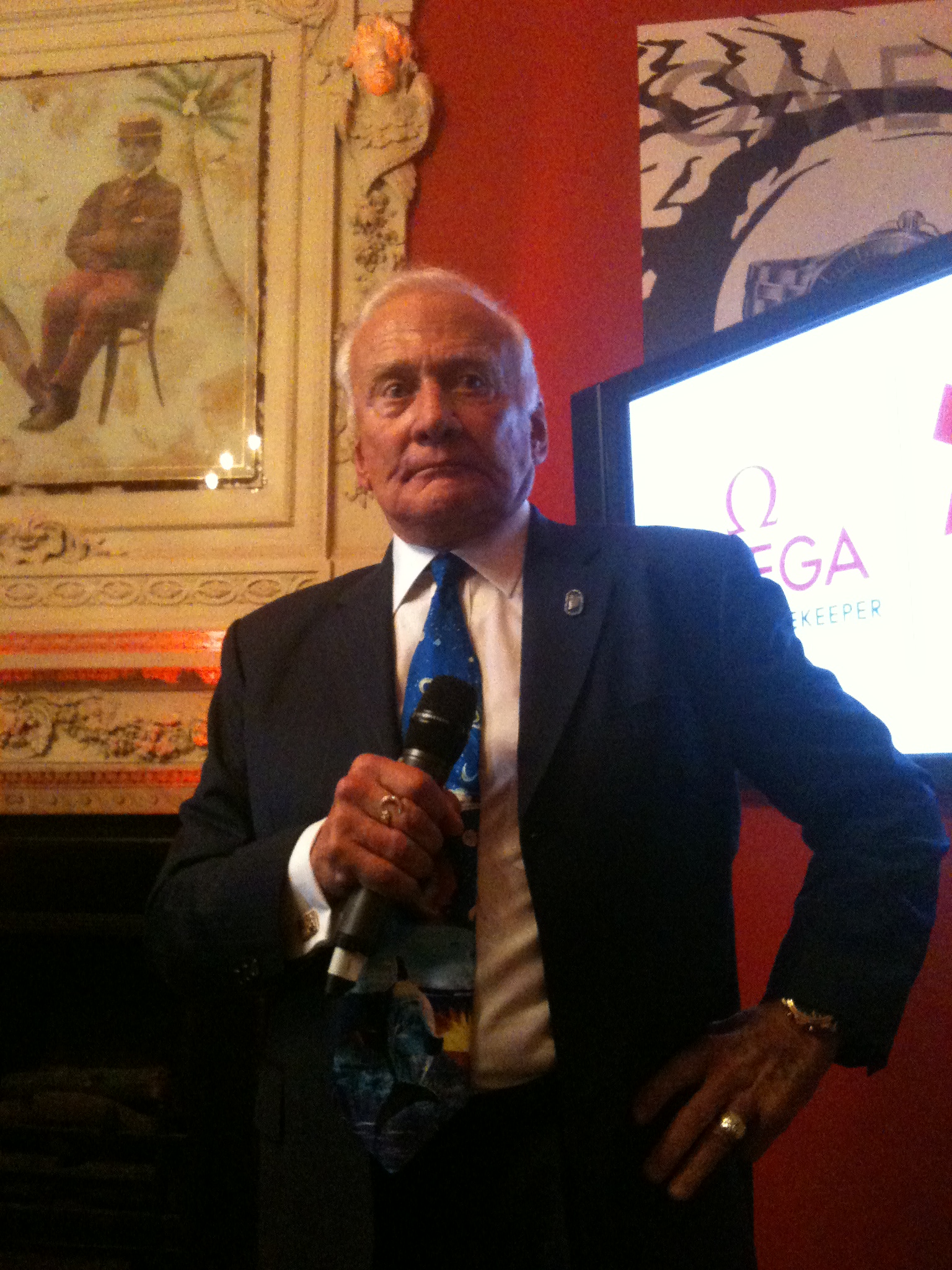
Living legend Buzz Aldrin at Soho House in London…alive, well & talking a lot of sense

Buzz Aldrin speaking at Soho House during the London Olympics

Buzz Aldrin speaking at Soho House during the London Olympics

Here in the middle of London Olympics fever it’s easy for me to identify my favourite moment from the Games & I’m afraid it isn’t sport related.  It was 2 August when my goddaughter Olivia & I went along to Soho House for an audience with Buzz Aldrin – yes that Buzz Aldrin – second man to walk on the moon & one of only 9 human beings still alive who have walked on the surface of our closest space neighbour.  And let’s face it – he’s the one we’re all familiar with as only one decent photograph was taken of poor Neil Armstrong on the moon.

To say we were excited doesn’t even come close.  Walking there I told Olivia the story of watching the Apollo 11 moon landing in July 1969 as a child.  My sister had already told her the same story many times.  As children we (with tens or even hundreds of millions of others) watched Apollo 11 blast off and felt we were there every step of the way with the 3 astronauts as they sped towards the Moon.

When it was near time to land, we were horrified to find that landing time was way after our bedtime but our dad promised us faithfully he would wake us in time to watch it live & he was true to his word.  He woke us up at 3.30am & carried us both downstairs wrapped up in blankets.  It’s something I’ll be eternally grateful to him for as those 8 days still go down as one of the most exciting periods of my life, even now over 40 years later.

I’m lucky enough to meet a lot of unusual & interesting people in the course of my work and life but I never thought I’d get to meet Buzz Aldrin in a million years.  To see him so vibrant & fresh at the age of 82 and with his adventurous spirit intact was a complete joy.  Anyway – enough old chat – here’s some of the interesting (to me anyway!) things he said on the day:

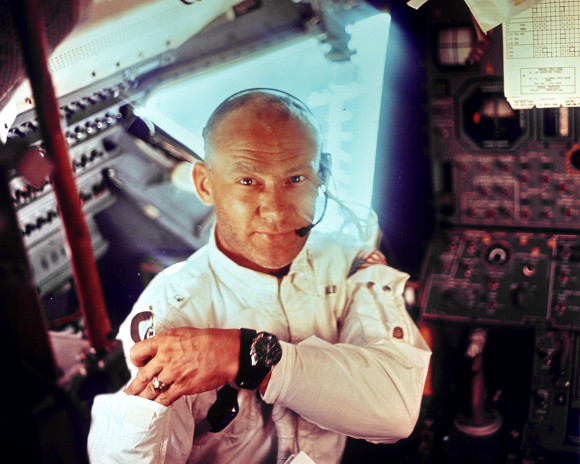
  • When asked why he wore his Omega Speedmaster on the Moon’s surface he said that it had been a personal gift from his government & being a watch man, he elected to strap it onto his wrist.  He did however go on to comment that when on the surface of the moon, the ability to know the local time in Houston, Texas was not that pressing.  He got a bit of a laugh with that comment.
  • On coping with fear he was very clear.  He said that unforeseen events can happen to anyone at any time but especially in combat situations (he was of course a decorated fighter pilot before becoming an astronaut).  His advice (maybe easier said than done for many people) is to stay calm & save your energy for when something happens & you need to do something about it.
  • He constantly reminded us that the Apollo missions had been a team effort involving hundreds of thousands of people all working towards a shared goal.  In terms of the USA putting a man on the moon, the goal was one publicly declared by the leader (JFK) and his specific order was that it was to take place before the end of the decade.  In 1963 everyone thought the goal was impossible but nevertheless “no-one was interested in failing” – what a priceless attitude.
  • His mother’s maiden name was Marion Moon.  I thought that was pretty weird – it isn’t that common a name.
  • He was given exactly the same name as his father at birth – Edwin Eugene Aldrin – and as a result was known as “Junior” when he was a child although his sisters called him Buzz.  He finally formally changed his name to Buzz in 1988 (quite an American thing to do I thought – but loveable – how awful to have the same name as one of your parents).  (I can say that with some authority…)

    Buzz Aldrin wearing his Omega Speedmaster on board Apollo 11

    Buzz Aldrin wearing his Omega Speedmaster on board Apollo 11

  • He’s passionate about STEM & talked about its importance in the school curriculum not once but twice.  He commented how disappointed he is that the US government does not, in his opinion, invest anything like enough money and attention into encouraging young students to study STEM subjects.  It’s the same in the UK.
  • Despite having a degree in aeronautics from MIT he wasn’t accepted onto the space programme the first time he applied as he hadn’t trained as a jet pilot; he persevered & once in the programme, was known to his peers as “Dr Rendezvous” because of his thesis work on “orbital space rendezvous”.
  • He was the first astronaut to use his experience as a scuba diver to train underwater; he went on to train others in these techniques (he showed us a recent photograph of him swimming with a whale shark in the Galapagos & advised us not to try this as it’s dangerous – the man’s 82!  He recently visited the site of the Titanic in a French submarine and he’s been to the North Pole in the last couple of years).
  • He wears a ring on his right hand in the shape of a planet and a crescent moon – you can see it in this photo – and check out his tie whilst you’re looking.
  • He was last man to board the command module and says he watched the sun rise as he climbed the gantry on 16 July 1969 and as he climbed, he reflected upon how wonderful his life had been; when he left the Eagle to begin his descent onto the Moon’s surface he closed the hatch over but didn’t shut it completely – I love that.
  • Being an engineer he loves computers (and his iPhone) but said that computers can make us lazy about reading books and he’s nervous that pretty soon a lot of people won’t know even the basics about how things (like cars for example) work.

The last of his quotes that I’ll leave you with is my favourite.  When asked what was the strangest thing he’d seen or felt in space he said “You know, when you’re on the Moon pretty much everything is unusual”.  Love it.

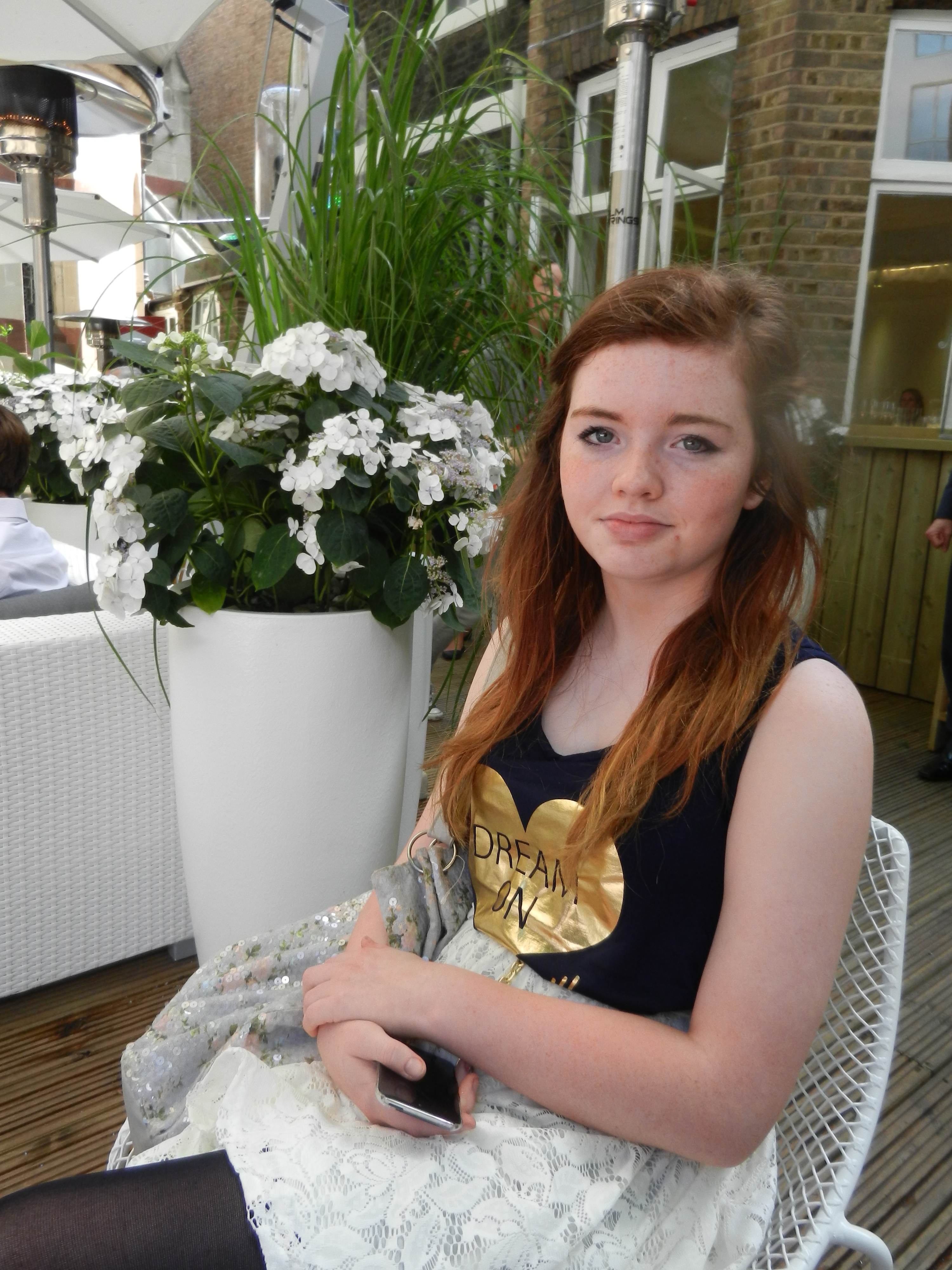
Olivia in the Soho House garden

Olivia in the Soho House garden

Thanks Buzz for being a complete inspiration all of my life and for being better in real life than I dared you would be.  Thanks to Alex Donaldson and Isabella Macpherson of Arts Co for squeezing Olivia & me onto the packed guest list and thanks to Ben Cackett of the Mayor of London’s office for organising such an amazing cultural programme to run in parallel to the London Olympic Games 2012 and for being such a wonderful host over the past two weeks.

Also – if you get an invite to a party at Soho House accept it at once.  It’s the coolest party venue in London and probably in the world.  Olivia & I believe it really is “Through the Looking Glass” & that footman on the front door really is a White Rabbit.  We checked the white flowers everywhere to see if they’d been painted…

Folks – there’s a lot more I didn’t write because it would have made the blog too long but if you ask questions in the comments I’ll do my best to answer them.  Buzz Aldrin answered 15 questions from the audience and he answered them thoughtfully & with considered & coherent lengthy answers plus I have a lot of notes.

Grayson Perry – an unusual man with an unusual view of the world

Grayson_perry_motorbike

Today I spent 4 or 5 hours in the British Museum.  It was wonderful.  There’s something there for everyone.  I have to admit to behaving today a bit like an accountant & a person who without fail always counts their lengths when swimming.  I grabbed the brochure entitled “A History of the World in 100 Objects”, picked out the 20 that interested me the most & then mapped out a route to view them.  I did my “objet” viewing on either side of the main reason for my trip – Grayson Perry’s exhibition “The Tomb of the Unknown Craftsman”.  All I can say is it’s on until 26 Feb (extension by popular demand) & if you haven’t seen it yet, you need to get down there, pay your tenner and consume this visual feast.

I know there’s been a lot already written about this exhibition, and photos were not permitted, so I’m going to keep this short.  It’s a mix of artefacts from the British museum which the artist has selected & then sometimes juxtaposed next to his own work (10 or so of his famous ceramic pots including one featuring Mark E Smith of The Fall entitled “Grumpy Old God pot”, iron sculptures of people, a coffin containing his ponytail from 25 years ago, needlework and huge tapestries, a tower he built out of stones he found on the road outside his squat in 1983, outrageous costumes he’s created & then worn, and of course his famous motorcycle – there in my photo, complete with Alan Measles riding at the back in his box).

What I liked most of all was some of the stuff Grayson had written here & there.  These are my favourites:

·         Reality can be new as well as old, poetic as well as factual and funny as well as grim;

·         Next to a selection of exquisite tiny portable lacquered Japanese shrines from the 1700s he tells us that the modern day equivalent of a portable shrine is the photo album we all carry about on our smartphones – I love that

·         The suggestion that CCTV is the modern version of carvings over cathedral doors depicting the Last Judgement & the damned going to hell – hahaha

Beautiful, just beautiful.  Don’t miss out.  Post up your comments if you’ve been along & enjoyed it as much as I did.  I look forward to reading them.

Some thoughts from Rosaleen Blair – entrepreneur, Dubliner and superwoman

Rosaleen Blair

Great female role model Rosaleen Blair speaking at an IIBN London event

As I’m sure the whole world is by now aware, I’m coming to the end of my first week living back in London.  Everyone I’ve met this past week or asked for help has been extremely welcoming and I’ve been fortunate enough to have been invited to a few really useful networking events.  Best of all, however, from the perspective of a newly arrived Irish entrepreneur in London has been the Irish International Business Network or IIBN as it’s known.  The link is here for anyone that would like to know more or find out how to join http://www.iibn.com/london/

I’m lucky enough to have been introduced to the original Wild Irish Guy himself, Damon Oldcorn, and it seems that once you know Damon, you don’t really need to know anyone else.  I’ve always found this to be a good strategy.  Bryan Keating was the first business person I met in Northern Ireland, he’s the exact same and it’s never done me any harm.

Thursday night’s IIBN event started with drinks & chat and it was very easy to circulate and get talking to a few people as everyone’s very friendly and open.  Everyone has an Irish connection even though many, like me, don’t have an Irish accent.  Don’t let that fool you! – they all know their Leitrims from their Letterkennys and their Dungloes from their Dingles.  Our diaspora is a beautiful thing.  There were bankers, recruiters, reps from private equity houses, lawyers, entrepreneurs, investors and no doubt many more besides.  If you’re Irish, in business and in London you need to join IIBN.

As part of the evening, our speaker was the charming and self-effacing Rosaleen Blair.  Rosaleen is one of those women who have achieved a helluva lot but doesn’t go around shouting that from the rooftops.  She just gets on with things.  Most of all, I liked the way she described the values her company operates by and I liked her statement of the 3 things she demands from people in her team and recruits against.  I’ve used these a few times already in conversation with others I’ve met this week but having chatted with Rosaleen on the evening, I don’t think she’ll mind.  They are as follows:

·         Trust – the members of a team have to really trust one another; of course this takes a bit of time

·         Collaboration – people need to be able & willing to work on projects with each other and to work hard to make that collaboration work

·         Sharing – Rosaleen hates it when people hold back knowledge & refuse to share it with other members of the team

I also loved what she said about encouraging a culture of “intrapreneurship” within your own organisation as a way of motivating and retaining the people in your team.  If anyone’s unsure what that means, it’s about encouraging positive aspects of entrepreneurial behaviour but within a large organisation.  It’s something we always tried to do at Learning Pool.

Rosaleen told us her story about how she arrived in London from Dublin in the 1990s, not knowing a soul but with a background in recruitment and having run a few small businesses in Ireland, believing herself to be fairly unemployable.  She went to work at Alexander Mann and over the course of time, persuaded her employer to allow her to try something new to fill a gap in the market and co-create adjacent services with clients (the first one being ICL/Fujitsu).  As it happened, she, working along with James Caan, became one of the early pioneers of what these days is known as RPO (Recruitment Process Outsourcing) and the rest is history.  In 2007, Rosaleen led her team through a £100m management buyout with the backing of private equity house Graphite Capital.  These days her company Alexander Mann Solutions employs 2,000 people working in 70 geographies and 42 languages.

Rosaleen also gave us some priceless bits of advice which I hope she won’t mind me passing on here to others:

·         When looking at which private equity house to go with, do some research and talk to some of the companies your main players have divested themselves of

·         As CEO, always keep your bank manager close & don’t give them any surprises; don’t pass that bank relationship off to someone else in your team

·         If your company is going to be working in some way with a private equity house, get yourself a CFO that has previously worked with a PE house, a CFO coming from a big corporate background won’t have the right sort of experience

·         Trust your own instincts and that of your team every day of the week over the advice given to you by external “experts”

Thanks Rosaleen, thanks IIBN and hello London!


What makes a great virtual team member?…time to practice what I preach

Paul_in_stansted_lounge

Today’s my last day in Northern Ireland for 6 months.  For the past 5 years I’ve managed a highly motivated part of the Learning Pool team who are absent from our Derry mothership & who work from home in England and Scotland.  Tomorrow I become one of them.  This past couple of weeks I’ve been really mulling this over & wondering what it will mean for me.  I’m also slightly worried that I may not be the exemplary virtual team member that I imagine I will, a carbon copy of the perfect remote worker in the image I have in my mind’s eye.

In my view, these are the qualities & behaviours of a great virtual team member:

·         superb communicator – in both directions – giving & receiving information; this applies equally to customers & colleagues

·         highly organised in terms of managing appointments, follow ups, phone calls, CRM updates, keeping your online calendar bang up to date

·         ability to work efficiently on the hoof (on trains, in cafes, at airports, in the car)

·         knack to really bond with people you don’t see face to face much – other virtual colleagues but also the people in the powerhouse or mothership – the people you need to actually do things for you that you can’t do yourself

·         planning your schedule to get the most out of each day by combining appointments & using common sense

·         gift for really knowing what’s going on beneath the surface at HQ, think that comes about by really listening to what your colleagues say

·         makes the best use of the available technology & doesn’t get bogged down in constant technofail

·         books travel well in advance to get the best prices

·         effective collector & disseminator of customer information back to the mothership team

·         self starter with a lot of drive

·         ability to complete & finish things (this one is tricky for me) in a fast paced & constantly moving environment.

From time to time I’ve been critical of how other people do some or all of the above.  I guess I’ll know by this time next week how I’m doing myself.  Any hints and tips from you, my dear readers, will be most welcome as always.

So what am I going to miss most over the next 6 months when I’m London based.  Folks – there’s no competition on that score.  The photo of Paul was snapped yesterday at Stansted airport.  He’d just finished a conference call with our tech team & is posting something up on Twitter.  As usual, we had a few right old laughs yesterday – despite both of us having a 3.30am start, a tricky meeting at the Cabinet Office and the usual mixed bag of rushing around London for meetings, juggling stuff as we go.  Along the way, and starting at 5.30am, we also discussed everything that both of us are working on, we did some long term strategic planning, we both chatted to a number of colleagues, customers and partners, sketched out a couple of new products or markets for existing parts of the Learning Pool portfolio, swapped the usual load of gossip (mainly about other entrepreneurs or businesses), exchanged views on the content of business books we are both reading (cuts down on individual reading time if your business partner reads it & gives you a précis of course), managed to have both breakfast & lunch in the most random of places, went through some sort of time/space portal at Stansted airport, took two plane journeys & two long drives each, but were emailing again when we got to our respective homes last night.  The relationship anyone has (should have) with their business partner is pretty intense and full on.  I’ll refer you to a previous blog of mine if you’re interested in reading more about this – it’s here https://kickingassets.co.uk/two-heads-are-better-than-one-10-pros-of-havi

We’ve been working together like this for 8 years, we rarely disagree and you couldn’t put a cigarette paper in between us.  I guess that’s what I’m going to miss most.


Job Hunting? Be careful you don’t cross the line into canvassing…

Ear_whispering

It’s a dog eat dog world out there, especially if you’re on the hunt for a job.  I’ve written a number of blogs over the past couple of years offering advice to people looking for new employment opportunities or getting ready to attend interviews and I always encourage people to be as proactive as they can.  This means being alert to opportunities as they come up, using your networks, sending carefully crafted emails or letters & cvs to organisations you want to work for, etc.  As we all know, a large percentage of jobs are never advertised – so it’s important that you get yourself on the radar.

However, you can go too far.  When that happens you can be in danger of either being disqualified for canvassing or you can just annoy someone so much that they put you on the “no thanks” list before you even get a chance to shine.

Recently I’ve started to receive large numbers of Linked In requests from people I don’t know.  Many of them are people that are looking for work.  Guys – this isn’t going to do you any favours.  First of all, I only connect with people on Linked In that I have met in real life & know and like.  I joked when David Cameron joined Linked In that he needn’t bother sending me a request as I wouldn’t accept it.  It’s the truth.  In my mind, it’s pointless being professionally “connected” with hundreds of people that I don’t know.  Twitter’s the place for that.

Sometimes, before I click the “ignore” option, I do take a look at the person’s Linked In profile.  Call that what you like – nosiness, curiosity, even politeness.  I live in Northern Ireland so if it’s a name I half recognise or someone that I think I may have met, I look at the profile to find out more information.  Surely that’s the point of having profiles.

I don’t then expect that person to send me a public tweet thanking me for looking at their Linked In profile & saying they hope Learning Pool will be in touch with them shortly.

This is so wrong on so many levels:

1.       If we’ve advertised job vacancies, we’re in a process and using social media in this way to promote yourself to people in the company could be construed by some to be canvassing, and that can result in your application being disqualified from the process.  In Northern Ireland we work within very strict recruitment guidelines in order to meet legislation around equal opportunities in employment.

2.       I might sit in on interviews from time to time and I might meet people before we offer them a job, but it will be our team leads that are driving the recruitment process at Learning Pool not me.  If you contact me outside of the process, I am unlikely to know anything about the particular process you are in (we advertised 10 vacancies in the press on 27 December) and even if I was interested in your experience and skillset, I’m unlikely to mention you to one of our team leads – they’ll pick it up themselves as part of their shortlisting activity.

If you’re looking for a job & want to work at Learning Pool, spend time & effort instead improving your cv (most of the ones I see are dire) and writing a decent covering letter.  Or spend time getting onto our radar before we actually go out to recruitment – so that we already know you.  There are many ways you can do this – intelligent commenting on our forums, writing an interesting personal blog & making us aware of that, conducting interactions with us on Twitter or coming along to our events & chatting to us.

I know that many of you will have opinions or questions about this topic and I hope we can have some debate in the comments section.  As always, love to have your input.

London Calling

Mary_and_paul_no_10

I’m getting ready to move to London in the New Year.  There, I’ve said it.  Learning Pool started life in London in a rented loft in Crawford’s Passage in Farringdon before shifting our HQ back to Derry.  We used to call our London base Crawford’s Pass amongst ourselves because it made it sound more Irish.  In our early days we were paranoid about customers knowing we were a Northern Ireland company in case it was a barrier to us doing business.  As the last 5 years have progressed, we became less coy about our origins as we cemented our customer relationships although we hung onto our London phone number.  These days, our customers love the fact that we’re an Irish company and some of them have even been to visit us at our office in Derry.  Others have even been brave enough to join our team.

Our fabulous Head of Content, Deborah Limb, joined us from another more famous e-learning company.  Deborah had never been to Northern Ireland before her first day at Learning Pool.  She arrived at our office on a cold, wet, Monday morning in November 2007, clutching the remnants of a sopping wet map in her hand.  She still claims she never saw daylight during that first winter.

Now it’s my turn to go back the other way and it’s a bittersweet feeling that I have.  I lived in London for 17 years before moving home to County Tyrone at the start of the new millennium.  I left the pushiness of the city behind & moved right into the middle of rural Ulster.  I’ll never forget waking up that first morning & hearing no sounds.  Nothing at all.  I remember the relief I felt & ever since that day, I’ve half felt as though I’m on holiday – a sort of working holiday where you work harder than you’ve ever worked before but your colleagues & neighbours are so friendly that it somehow compensates you.

I quickly learned to be less brusque & more chatty in my interactions.  More talk about the weather & people you know & less focus on the agenda is the Northern Irish way.  Gradually the sharp edges from all those years spent living in the city were worn down a little.  Of course I’ve been back in London pretty much every week since 2000 – sometimes twice a week – but always as a visitor, staying in a hotel room, running for a plane home as soon as the meetings are finished.  I’m wondering how I’ll slot back into the hurly-burly of London life after the deep, deep peace of country living (quoted with a nod to Mrs Patrick Campbell).

So why am I as a person and why are we as a business doing this?  I guess we’re fed up with fighting for what’s right (that it should be just as easy to do business from Northern Ireland as it is from any part of the UK or indeed Europe) & accepting what’s reality.  Like it or not, London is indeed where UK government’s beating heart lies.  It’s also where a large number of our customers, a huge number of potential customers and some of the people we’d like to work more closely with are based.  On top of that, our Northern Ireland location is stifling Learning Pool’s growth as there just aren’t the skills here that we need to recruit in to grow our business.  We’ve raised this point many times with Invest Northern Ireland.  We’re further hampered by having an ornament of an airport 5 miles from us in Derry that we never use as the flight times aren’t conducive to being anywhere on time to do business – and the government agencies and politicians seem more interested in in-fighting & scoring points off each other than looking outwards & making Northern Ireland an easier place from which to operate internationally.  In summary, we’ve concluded we’re missing out on opportunities and holding ourselves back by not having a London presence.  And I think that’s a very sad state of affairs.  Learning Pool was recently confirmed by Deloitte to be Northern Ireland’s fastest growing tech company & the 6th fastest growing on the island of Ireland, but we have to look to London in order to continue our expansion.

Of course there’s plenty of upside.  I’m looking forward to being back in the heart of the capital for a six month period and I’m intending throwing myself into the whole London work/social scene and spending plenty of time with friends & colleagues, old & new.  I’m looking for somewhere to base Learning Pool London right now so watch this space & all will be revealed.

I know this is an emotive topic, especially for other Northern Ireland businesses – so I’m looking forward to your views & a lively discussion in the comments below.  Keep ‘em coming!


Forget Fight Club, what are the rules of Start-Up Club?

Fight_club

We all know the first rule of Fight Club – (shhh – don’t mention it) – but what are the rules of Start-Up Club?  These are the 10 Rules I’d suggest to someone starting out with a new business:

Rule 1 – Just Do It – the time will never be right & there’s no point in procrastinating, obsessing over the fine detail (you’ll find out soon enough you can’t control things anyway) or delaying.  Grasp the nettle & get going.  Entrepreneurs have many sayings but one that I like a lot is “Leap and a net will form”.  Well – it either does or it doesn’t but there’s only one way to find out.

Rule 2 – seek out a great name and then get a great strapline.  It might not be the one you start out with but keep looking.  All our companies (so far) have had great names including my very first company which was called Kicking Assets.  Keep thinking – it doesn’t cost you anything to think but this is stuff that makes a high impact.

Rule 3 – network like mad both online & in real life.  Not to the exclusion of all else of course but do work at it.  I’ve written a previous blog about networking which you can read here https://kickingassets.co.uk/so-you-want-to-network

Rule 4 – be well informed, there’s no excuse these days not to be – we have the internet!  Join the appropriate groups (online & real life, like Northern Ireland’s Digital Circle) & talk/listen to other entrepreneurs.  You have to work at this too.

Rule 5 – ask for help if you need it.  Most people are generous with their time & advice and everyone wants you to be a success.  When people help you out, be gracious & don’t abuse their good nature.

Rule 6 – look for innovation in your product or service, your product delivery channel and also your business model.  Innovation in your business model can be a real differentiator.  Again – this doesn’t cost you anything, you just need to think about it.

Rule 7 – don’t go it alone.  Find a business partner or a couple of non execs or perhaps seek out a mentor or join a collaborative network.  Starting a business is too hard for a person to do by themselves and a problem shared is a problem halved.  I have another blog about this specifically which you can read here if you want to know more https://kickingassets.co.uk/two-heads-are-better-than-one-10-pros-of-havi

Rule 8 – get good advice.  Shop around for an understanding bank (we quickly moved away from our first bank when they wouldn’t support our growth strategy & these days bank with the fabulous Northern Bank) and once you find them, have an open and honest relationship with your bank manager.  Talk to other entrepreneurs and start-ups about the accountants and legal firms they use.  Look for modern professional advisers that understand online businesses and who use technology and social networking themselves.  Cut a good deal by promising them they’ll get a decent payback when you exit.  Agree all your fees up front.  Never get any of these guys out of the Yellow Pages or equivalent.

Rule 9 – work hard and always be open and alert to opportunity.  Usually it doesn’t come up & slap you in the face – you need to be watching out for it.  I’m afraid working hard has to be a given.  Without doing it you will fail and anyone that tells you anything different than that is a liar.

Rule 10 – have some fun.  Running your own business or working in a start-up is the most fun you will ever have at work.  Sure it’s hard work & the lows can be pretty awful – but the highs are AMAZING & you get to hang out with some great people in your own team.

Send me your own tips in the comments below – I can’t wait to read them.

Billy Bragg…songwriter, activist & national treasure

Mary_in_billy_bragg_tshirt

I’ve been a fan of Billy Bragg all my adult life – which is pretty much all his adult life.  The photo above was taken today & features my rather tatty but much prized Billy Bragg t-shirt bought in 1985 & survivor of so many wardrobe clear-outs.  I almost threw it away when we moved from London to Northern Ireland but I couldn’t bear to.  It reminds me too much of the miner’s strike & the stuff that went on back then.

Yesterday, the Learning Pool crew was breakfasting in the Gibson in Dublin following the Deloitte Fast 50 Awards ceremony on Friday night.  I don’t have to tell you how late we went to bed.  Suffice to say it was a similar time to when I often get up.  At breakfast, Billy Bragg was at the next table.  I couldn’t let the opportunity pass.  I did, however, have the decency to wait until he’d finished his breakfast & read the newspaper before I approached him for a chat.

He was exactly as I imagined he would be & I was delighted to hear he was heading over yesterday afternoon to the Dame St protests in Dublin to show a bit of support & play an impromptu gig on a makeshift stage assembled by the protesters & activists.  Good on yer Billy & good luck with your Irish tour.  Might see you Friday night at the Empire in Belfast.  Details are here if anyone else fancies it too http://www.billybragg.co.uk/gigs/gigs.php

Billy Bragg stories welcome via the comments as always.